.png)

Planning Outdoor Spaces for ARAMCO and Corporate Compounds in Saudi Arabia
What makes outdoor spaces for ARAMCO and corporate compounds in Saudi Arabia work? Three things: shade where people actually sit, a play area parents can watch from a bench, and walking paths that lead somewhere useful. Get these right and residents use the space daily. Get them wrong and even a well-landscaped compound feels empty by 2 p.m.
Most planning problems start with the same mistake. Teams pick outdoor playground equipment and furniture first and think about daily use later. A slide too hot to touch at noon, a bench where nobody can see the playground, a path that crosses the entry road: these are small decisions on a drawing, but residents live with them every day.
This guide shows how to approach compound outdoor design the other way around. You will learn:
- Which outdoor zones a family or staff compound needs
- How heat, sun and dust should change your material and layout choices
- What to compare before buying, beyond price
- Which planning mistakes cost the most to fix later
Why Do Outdoor Spaces Matter in a Corporate Compound?
Outdoor spaces matter because they are the part of a compound that residents use every day. A building is where people sleep. The outdoor area is where they unwind, meet neighbors and let their children play.
Here is what a good outdoor space does for a compound:
- Gives employees a break. A shaded bench or a quiet path is often the only time outside in a long workday.
- Keeps families on site. When a safe play area is close to home, parents don’t need to drive elsewhere to entertain their children.
- Builds a sense of community. Neighbors rarely plan to meet. They talk because they share a bench, a path or a play area.
- Shows in how residents rate the compound. People judge a compound by whether they had somewhere to sit, somewhere safe for their children and somewhere to walk. Trimmed grass does not come into it.
A lawn that only looks green does none of this. A shaded bench, a safe play area and a good walking path do.
Key Planning Factors Before Designing Compound Outdoor Areas
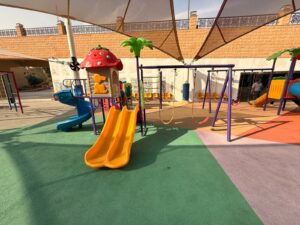
Before choosing playground equipment, shade structures, benches, or site furniture, the planning team should look at the basics first. A good outdoor planning environment is not only about products. It is about making the right choices for the site, the climate, the users, and the long-term upkeep.
Who will use the outdoor space, and how often?
Plan the space around who lives there. Families need play areas and benches near homes. Single staff need walking paths, quiet seating and exercise stations. Most compounds have both, so plan for each group:
- Families with children: play area, seating in view, open space
- Single professionals: quiet seating, walking routes, exercise stations
- Older residents: smooth paths, shaded benches, short distances
- Visitors: a clear entry and somewhere to wait
- Maintenance staff: vehicle access and easy cleaning routes
Then mark the areas used every day. Those get the strongest materials and the best shade.
How does Saudi heat affect outdoor design?
Heat decides what gets used. People and children avoid anything too hot to touch or sit on.
By noon, a metal slide or handrail in direct sun is too hot for a kid to touch. This is the first thing that gets missed in playground planning the material spec looks fine on paper, but nobody checked what happens to it at 1pm in July. The fix is simple: UV-coated equipment, and put it where a building or tree actually blocks the sun for part of the day.
Shade is also why some seating areas never get used. Walk any compound in the afternoon and you’ll see people clustered under the one tree or awning, while the “nicer” open seating twenty feet away sits empty. People don’t sit where it looks good. They sit where it’s not 45 degrees.
Dust is the quieter problem. Textured stone, rough concrete, mesh surfaces — they all collect grit, and someone on the facilities team ends up cleaning them constantly. Smooth, sealed finishes take five minutes to wipe down. Over a hundred benches or play units, that difference adds up to actual staff hours saved every week.
None of this is complicated. It just has to be decided before installation, because moving a shade structure after the fact costs more than placing it right the first time.
What should you compare besides price?
Compare how long the product lasts, not just what it costs today. A cheaper product that fades, cracks or needs repairs often costs more over time. Check:
- Upfront cost
- Life span in Saudi sun and dust
- Cleaning and maintenance time
- Spare parts availability
- Cost of early replacement
Best Types of Outdoor Spaces for Employee Housing and Corporate Communities
Not every compound needs the same outdoor setup. The right mix depends on who lives there, how the space is used, and what kind of daily life the site is meant to support. In employee housing compounds and corporate communities, the best outdoor spaces are usually the ones that are simple, useful, and comfortable to use again and again.
How do you choose playground equipment for a compound?
Choose equipment that is safe for the children’s ages, strong enough for daily use and easy to maintain. Color and style come last.
Separate the age groups. When toddlers and ten-year-olds share one zone, one group gets bored and the other gets hurt. Give young children low, simple units. Give older children climbers and taller slides. Keep a gap or low barrier between them.
Check the surface. Every unit needs safety flooring under and around it, such as poured or tiled rubber. Swings need extra clearance on all sides. Ask suppliers if their equipment and surfacing meet EN 1176 and EN 1177.
Plan for heat. A metal slide in direct sun is too hot to touch by midday. Choose UV-resistant plastics and coated steel, and place the play area where a building or tree blocks the afternoon sun.
Match the unit to the use:
- Slides: good for daily family play
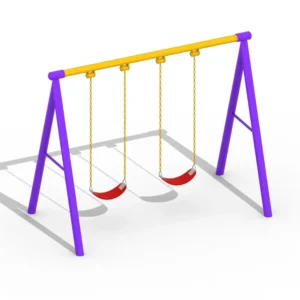
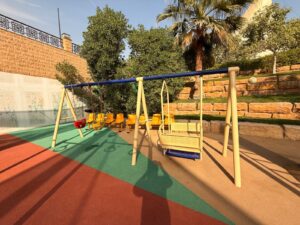
- Swings: popular, but need the most space
- Climbers: suit active older children
- Multi-play units: suit zones that need several activities in one footprint
For bench placement and installation checks, see the supervision section below.
What Outdoor Fitness Equipment Works Best in a Compound?
The best outdoor fitness equipment for a compound is simple, low-maintenance and easy to use without training. Stations like a chest press, leg press and walker suit shared use in Saudi heat. Residents can start without a gym membership or a trainer.
Equipment that suits most compounds:
- Push-up and dip station: builds arms and chest, and needs almost no upkeep
- Chest press and shoulder press stations: upper-body strength using the user’s own body weight
- Lat pull down station: back and arm exercise with a simple seated movement
- Leg press machine: lower-body strength, easy for beginners
- Waist twisting machine: gentle movement that suits older residents
- Walker or glide machine: light cardio for all ages
Where should outdoor gym equipment go in a compound?
Place it near a walking path and away from car traffic. Leave enough space between machines so two people can exercise at once, and ask your supplier for the safety zone each unit needs.
How do you protect outdoor fitness equipment from Saudi heat?
Add a shade structure or a cover, because bare metal gets too hot to use in summer. Choose powder-coated or UV-resistant finishes, install on a stable, safe surface, and inspect moving parts on a fixed schedule.
Where should seating go in a compound?
Put seating where people already stop: beside play areas, along walking paths, near entrances and at the edge of green corners. In the afternoon, people crowd under the one tree or awning while open benches twenty feet away stay empty. Shade decides where people sit.
What works well:
- Benches with a view of the play area
- Pergolas over small gathering spots
- Rest points along longer paths for older residents
- Picnic tables near open lawns for family use
- A trash bin within a few steps of every seating spot
Choose smooth, sealed finishes that wipe clean. Rough stone and textured surfaces collect dust and cost cleaning teams time every week.
Quiet green corners for relaxation and informal breaks
Not every outdoor area needs to be active. Quiet spaces are also important, especially in compounds where residents want a break from indoor routines, traffic, and busier shared zones.
These areas can include:
- small landscaped pockets with greenery
- shaded benches in calmer corners
- simple walking edges or resting points
- soft visual separation from louder activity zones
- clean and comfortable spaces for short breaks
These kinds of quiet outdoor areas support relaxation and make the site feel more balanced. They work well as landscaped relaxation zones and can also serve as passive recreation spaces for residents who want calm, not activity.
Multi-use open spaces for events, small gatherings, and flexible use
Some outdoor areas work best when they are left open and flexible. A multi-use space can support different needs over time without being limited to one fixed purpose.
These areas may be used for:
- small community gatherings
- children’s free play
- seasonal use or family events
- informal group activities
- temporary seating or light recreation
In larger compounds, these open zones can become useful community event spaces without needing major built structures. They also support versatile outdoor planning because they can change based on the needs of the residents. Well-sized open recreational areas give the site more flexibility and help avoid a layout that feels too rigid.
Outdoor Furniture and Site Elements That Add Real Value to Compounds
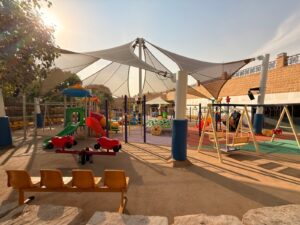
Outdoor areas do not become useful through large features alone. Often, it is the smaller site elements that improve comfort, cleanliness, movement, and daily convenience. The right mix of outdoor site furniture can make a compound easier to use and easier to maintain.
Benches, pergolas, and shaded seating solutions
Seating is one of the most important parts of a successful outdoor area. Without it, even a well-planned site can feel incomplete. Residents need places to rest, wait, supervise children, or spend time outdoors comfortably.
Useful seating solutions often include:
- benches along walking routes
- shaded sitting areas near play zones
- pergolas over gathering spots
- seating near entrances or shared spaces
- rest points for older residents
In many projects, public space furniture in Saudi Arabia needs to support both comfort and durability. Shaded seating becomes even more important in compounds where outdoor use depends heavily on protection from direct sun.
Outdoor dustbins and cleanliness-supporting site furniture
Cleanliness has a direct effect on how a compound feels. Even a good outdoor layout can lose value quickly if waste is not managed properly. That is why dustbins should be treated as a practical part of the site plan, not an afterthought.
Good placement usually means:
- bins near seating and gathering areas
- waste points close to play and recreation zones
- easy access for cleaning teams
- designs that match the site visually
- durable units made for outdoor use
Strong outdoor dustbins support a cleaner and more organized environment. They also reduce maintenance problems and help shared areas stay presentable throughout the day.
Picnic tables, rest areas, and family-use furniture
Some compounds benefit from furniture that supports longer and more social use. Picnic tables, group seating, and family-use furniture can make outdoor areas more inviting for shared time.
These features work well in:
- family sitting zones
- green pockets and open lawns
- shaded community corners
- areas near children’s play spaces
- small gathering points in the site
When chosen well, these pieces help residents use the outdoor environment in a more natural way. They also add value without making the site feel overbuilt.
Wayfinding, barriers, and safety-supporting accessories
Not every useful outdoor element is made for comfort. Some are there to improve movement, order, and safety. These details help the site work better for both residents and staff.
Important site accessories may include:
- wayfinding signs for easier movement
- low barriers to define safe zones
- separators around play or pedestrian areas
- protective edges where needed
- clear markers for paths and shared spaces
These elements help the site feel more organized and easier to understand. In family compounds especially, they can support safer movement and better use of shared areas.
How should a compound layout support parent supervision?
A parent should be able to sit down and still see their kid on the slide. That one requirement decides where benches go, and it gets ignored more often than it should. Play areas tucked behind a wall or planted screen might look better in a rendering, but nobody actually uses them because you can’t watch your children from anywhere nearby.
Walking paths matter too. If the only way to reach the playground crosses the road cars use to enter the compound, that’s a problem someone will eventually get hurt over. Keep pedestrian routes and vehicle routes separate, and put quiet corners far enough from play areas that neither one bothers the other.
None of this needs an engineer. It needs someone walking the site plan and asking: where would I actually sit if I had a kid here, and can I see them from there? If the answer is no, move the bench.
Installation matters just as much as placement. A swing set anchored properly outlasts one that isn’t, no matter how good the material is. Check the joints and fittings every few weeks — most safety problems show up as a loose bolt or worn surface long before anyone gets hurt.
Common Mistakes When Planning Outdoor Spaces for Large Compounds
Large compounds often have enough space, but the planning still falls short. The problem is usually not the size of the site. It is the wrong decisions made at the start. When outdoor areas are planned without real user needs in mind, the result may look complete but still feel weak in daily use.
Focusing only on looks and ignoring daily usability
A space can look neat in drawings and still fail in real life. This happens when planning is based only on appearance.
Common signs of this mistake:
- attractive layout but poor day-to-day use
- seating placed where people do not need it
- open areas with no clear purpose
- nice landscaping but no functional family spaces
- outdoor zones that look good but stay empty
In compounds, usability should come before decoration.
Choosing low-cost products with high replacement risk
Low prices can look attractive at first, but weak products often cost more later. In large compounds, replacement and repair can become a bigger burden than expected.
This mistake usually means:
- early damage or fading
- more frequent maintenance
- higher replacement costs
- poor long-term value
- weaker site appearance over time
For compound projects, durable products usually make better sense than cheap short-life options.
Not planning for different user groups within one compound
A large compound rarely serves one type of resident only. It may include families, single staff, children, older residents, visitors, and support teams.
Problems start when planning ignores this mix:
- children’s areas without nearby seating
- quiet users left with no calm spaces
- older residents facing difficult movement
- visitors lacking clear access points
- shared spaces that suit one group only
A better site gives each user group something useful.
Treating playgrounds, furniture, and fitness as separate decisions
Outdoor planning works best when everything is connected. Playgrounds, seating, fitness, shade, and walkways should support each other.
When they are treated separately, the site often ends up with:
- poor flow between spaces
- activity zones placed without logic
- seating far from where it is needed
- fitness areas with weak access or comfort
- a layout that feels broken instead of planned
The best compound outdoor spaces feel joined together. They work as one system, not as random parts.
To avoid these common mistakes, outdoor planning should be practical, climate-aware, and user-focused from the start. Ebaza Gardens helps create compound outdoor spaces that are easier to use, safer to manage, and better suited to Saudi living.
What Procurement Teams and Project Managers Should Check Before Buying
Before buying outdoor products for a compound, teams should look beyond catalog images and price. The right choice should match the site, the users, the climate, and the long-term needs of the project.
Product specifications, material quality, and warranty questions
Start with the product itself. Buyers should understand what they are getting and whether it suits Saudi outdoor use.
Key checks include:
- product dimensions and space needs
- material quality
- suitability for outdoor conditions
- structural strength
- warranty coverage
Clear specifications help reduce mistakes later.
Installation capability, lead times, and project coordination
A good product still needs proper delivery and installation. This matters even more in large compounds.
Teams should check:
- installation support
- site readiness requirements
- lead times
- delivery planning
- coordination with project schedule
This helps avoid delays and poor on-site execution.
Customization options for different compound sizes and user types
Not every compound needs the same setup. Some projects need more family zones, while others need more staff-focused outdoor areas.
Useful questions include:
- Can the layout be adjusted to the site?
- Are there options for different user groups?
- Can sizes or combinations be changed?
- Does the product range fit different parts of the compound?
Flexible options make planning easier and more practical.
After-sales support and maintenance readiness
Outdoor products should stay manageable after installation, not become a burden for the site team.
Buyers should ask about:
- maintenance support
- spare part availability
- inspection needs
- repair guidance
- long-term service readiness
Strong after-sales support gives more confidence, especially in larger projects.
Why Turnkey Outdoor Solutions Are Often Better for Large Compound Projects
Large compound projects involve more than choosing products. They also require proper planning, smooth delivery, correct installation, and long-term usability. That is why turnkey outdoor solutions often work better for these projects.
Better coordination between design, supply, and installation
When one team handles the full process, the project moves in a more organized way. Design choices, product supply, and installation planning stay aligned, which helps reduce confusion and delay.
More consistent quality across the full site
Large compounds usually include different outdoor zones, such as playgrounds, seating areas, fitness spaces, and site furniture. A turnkey approach helps keep the quality, style, and finish more consistent across all these areas.
Easier maintenance planning after project completion
A well-managed turnkey setup also makes post-installation planning easier. Facility teams can better understand the materials used, the maintenance needs, and the right way to care for the outdoor areas over time.
Less risk for procurement and facilities teams
For procurement and site teams, a turnkey model can reduce many common project risks. It helps avoid coordination gaps, product mismatch, installation issues, and unnecessary follow-up work after handover.
For large compound projects, turnkey outdoor solutions often bring better control, better consistency, and a smoother overall result.
How Ebaza Gardens Can Support Outdoor Projects for ARAMCO and Corporate Compounds
Planning outdoor spaces for large compounds needs more than product selection. It requires a clear understanding of user needs, Saudi climate conditions, site layout, and long-term usability. Ebaza Gardens supports this process with solutions suited to residential, institutional, and corporate outdoor projects in Saudi Arabia.
Outdoor-focused product expertise for Saudi project conditions
Outdoor projects in Saudi Arabia need to perform well under heat, sun, dust, and regular use. The focus should always be on practical, durable, and easy-to-maintain solutions that suit real site conditions and long-term outdoor use.
Solutions for playgrounds, seating, fitness, and site furniture
Compound planning usually includes more than one outdoor zone. A complete setup may involve children’s play areas, shaded seating, outdoor fitness spaces, and site furniture that work together to create a more usable and balanced environment.
Support for residential, institutional, and corporate outdoor environments
Different projects need different outdoor solutions. A family compound, staff housing site, school, or corporate facility will not use space in the same way. That is why outdoor planning should match the users, the site purpose, and the daily demands of the project.
Project-led approach from selection to installation
A strong outdoor project depends on more than buying products. It also depends on proper selection, site fit, and correct installation. With the right project approach, outdoor spaces become more practical, better planned, and easier to manage over time.
Building Better Outdoor Spaces for ARAMCO and Corporate Compounds in Saudi Arabia
The best Outdoor Spaces for ARAMCO & Corporate Compounds in Saudi Arabia are rarely defined by landscaping alone. They come down to whether a parent can watch their kid from a bench, whether there’s shade to sit in at 2pm, and whether the walking path actually leads somewhere people want to go. Compounds that get these three things right don’t need to try hard to feel finished — people just use the space every day, without being told to.
Get the layout, shade, and safety right, and everything else people usually chase separately — longer resident stays, a stronger sense of community, better resale or leasing appeal — shows up on its own. That’s what makes Outdoor Spaces for ARAMCO & Corporate Compounds in Saudi Arabia worth the planning effort. It was never a separate checklist item. It’s just what happens when the basics are handled properly from the start.
Contact Our Projects Team for outdoor solutions tailored to Saudi residential and corporate communities.