.png)

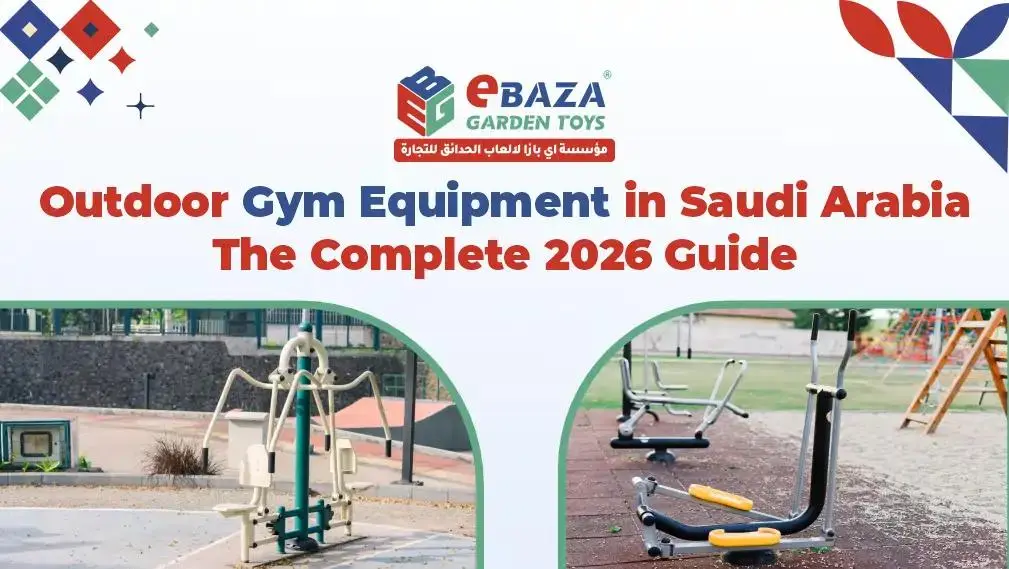
Outdoor fitness equipment in Saudi Arabia is becoming a more important part of parks, schools, compounds, public spaces, and residential projects. As more outdoor areas are designed for health, movement, and community use, the focus is no longer only on adding exercise machines. It is also about creating fitness spaces that stay strong, safe, and usable in Saudi weather. When equipment fades, wears out, or stops working properly, it affects the exercise experience and reduces the value of the space.
This is why outdoor fitness equipment is getting more attention across Saudi Arabia in 2026. People want outdoor spaces that support daily activity, improve community life, and last over time. From public wellness areas to private developments, outdoor gym equipment in Saudi Arabia projects now need to balance durability, function, and practical design.
In this guide, you will learn how outdoor fitness spaces are being used, which equipment types are common, what features matter in local conditions, and why materials, layout, and maintenance all play a role in long-term performance. The article also explores the growing importance of outdoor exercise equipment Saudi Arabia projects for parks, schools, compounds, and modern outdoor developments.
Outdoor fitness equipment refers to weather-resistant exercise machines installed in open public or private spaces like parks, schools, and compounds for strength, cardio, and stretching workouts.
Outdoor gym stations are installed in both public and private projects, including:
| Feature | Outdoor Equipment | Indoor Equipment |
| Exposure | Sun, heat, dust, humidity | Climate-controlled |
| Frame | Reinforced, corrosion-resistant | Standard steel/frame |
| Finish | Weatherproof coating | Standard paint/upholstery |
| Moving parts | Sealed, low-maintenance | Regularly serviced |
| Use case | Public/shared, high traffic | Private/controlled access |
A well-balanced outdoor fitness area combines strength stations (leg press, chest press, shoulder press, lat pull down), low-impact movement stations (strolling machines, waist twisters), and bodyweight stations (push-up/dip bars) allowing multiple age groups and fitness levels to use the same space.
The best outdoor fitness setups combine three categories: strength equipment (leg press, chest press, shoulder press, lat pull down), low-impact/cardio equipment (strolling machines, waist twisters), and bodyweight stations (push-up and dip bars). Combining all three lets one fitness area serve seniors, adults, and casual users without needing separate indoor equipment.
| Equipment | Primary Muscle Focus | Users at Once | Best For | Impact Level |
| Push-up & dip station | Chest, arms, core | 1–2 | Bodyweight strength training | Moderate |
| Double waist twister | Waist, lower body balance | 2 | Light daily movement, seniors | Low |
| Single lat pull down | Back, shoulders, arms | 1 | Focused upper-body strength | Moderate |
| Double strolling machine (air walker) | Legs, cardio | 2 | Warm-up, daily cardio, all ages | Very low |
| Double leg press | Legs, glutes | 2 | Lower-body strength building | Moderate |
| Double shoulder press | Shoulders, arms | 2 | Upper-body strength, adults | Moderate |
| Double chest press | Chest, arms | 2 | Structured strength training | Moderate |
Impact level reflects joint stress and physical intensity — useful for matching equipment to schools, senior-focused compounds, or general community use.
Supports bodyweight training for chest, arms, and core without moving mechanical parts making it lower-maintenance than machine-based stations. Common in schools and compounds where simple, durable equipment is preferred over complex machinery.
Adds structured back and shoulder training to an outdoor layout. Useful in larger installations that already have cardio/low-impact stations and need a strength-training counterpart commonly paired with leg press and chest press stations to form a complete strength circuit.
Targets lower-body strength (legs, glutes) with a seated, controlled movement pattern — generally considered lower-impact on joints than standing leg exercises, making it suitable for a wider age range than dip stations.
Built for shoulder and arm strength; the double-unit design allows two users to train simultaneously, which suits higher-traffic public parks better than single-user stations.
Provides chest and arm strength training with a pressing motion. Frequently installed alongside shoulder press and leg press stations to complete a three-station strength circuit.
A low-impact, rotational movement station suited to light daily exercise and users with limited mobility, including seniors. The dual-user design makes it practical for family or shared use.
Double Strolling Machine (Air Walker)
The most beginner-friendly station in most outdoor gyms — a smooth striding motion with minimal joint impact. Frequently the first station used in a workout circuit as a warm-up, and often the most-used station in family-oriented parks due to its low barrier to entry.
Ebaza Gardens has also supplied and installed outdoor fitness equipment for a public project in Abha, Saudi Arabia. The project included outdoor fitness machines for park and community use, with the equipment selected for regular outdoor activity and long-term use.
See the outdoor fitness project in Abha, Saudi Arabia to view the installed equipment and project details.
Choosing outdoor exercise stations depends on 5 factors: user type and location, frame/coating protection, safety clearances, layout planning, and installation/warranty support. Below is a step-by-step guide.
Different sites need different equipment setups:
| Location Type | Recommended Approach |
| Public parks | Heavy-duty, multi-user machines built for daily high traffic |
| Schools | Age-appropriate, simple-to-use equipment with added safety features |
| Residential compounds | Mixed cardio, strength, and low-impact stations for varied age groups |
| Villas / private gardens | Compact, space-efficient stations (1–3 units typical) |
| Hotels, resorts, hospitals | Equipment matched to guest/patient mobility levels and available space |
High-traffic public sites require commercial-grade durability ratings; private installations can prioritize compactness over heavy-duty specs.
Saudi Arabia’s climate (high heat, UV exposure, dust, and coastal humidity in some regions) makes protective specification critical. Check for:
Many reputable manufacturers reference EN 16630, the European standard for outdoor and playground fitness equipment covering safety, durability, and testing requirements. Asking a supplier whether their equipment is tested to this standard is a useful benchmark, even outside the EU.
Outdoor fitness stations need adequate space and safe design:
Measure the site first, then select equipment — not the reverse. A good layout includes:
Fewer, well-placed stations typically outperform a densely packed layout, both for safety and usability.
Before finalizing a purchase, confirm with the supplier:
Poor installation is one of the most common causes of early equipment failure — confirming this upfront reduces long-term risk.
We at Ebaza Gardens can support you with more than just equipment supply. From product selection and placement suggestions to installation guidance and after-sales support, the team helps you make more practical and confident decisions for your outdoor fitness space.
Get a free quote to find the right solution for your project.
The price of outdoor exercise equipment in Saudi Arabia can vary from one project to another. That is because the total cost does not depend on the machine alone.
It also depends on the number of stations, material quality, site conditions, installation work, and the overall project scope. This is why two outdoor fitness projects can have very different pricing.
Because every site and requirement is different, quote-based pricing is usually the best way to understand the real cost. It helps match the equipment, layout, and installation needs to the actual project instead of giving a general price that may not fit the space.
Outdoor fitness equipment in Saudi Arabia needs inspection roughly every month, cleaning every 1–2 weeks in dusty areas, and a full structural check every 6 months — heat, UV, and dust are the primary causes of early wear.
| Task | Recommended Frequency | Why |
| Visual inspection (bolts, joints, frame) | Monthly | Catches loosening before it becomes a safety hazard |
| Cleaning (dust, dirt removal) | Every 1–2 weeks (more often in dusty/interior regions) | Dust infiltrates bearings and moving joints, accelerating wear |
| Bolt tightening / torque check | Monthly | Heat cycles (hot days, cooler nights) cause metal expansion/contraction that loosens fasteners over time |
| Lubrication of moving parts | Every 2–3 months | Heat breaks down standard lubricants faster than in indoor equipment |
| Coating/rust inspection | Every 3 months | UV and humidity degrade powder coating and paint over time |
| Full structural safety audit | Every 6 months | Identifies fatigue, corrosion, or wear not visible in routine checks |
| Deep clean / pressure wash (low pressure only) | Quarterly | Removes embedded dust/salt buildup without damaging seals |
Coastal cities (Jeddah, Dammam, Khobar) should shorten corrosion-check intervals due to salt-air exposure. Interior/desert regions (Riyadh, Qassim) should shorten cleaning intervals due to higher dust load.
Check monthly for:
Fix small issues immediately; a loose bolt today is a safety failure risk within weeks under daily public use.
Dust accumulation is faster in Saudi Arabia’s interior and desert-adjacent regions than in coastal cities. General guidance:
Saudi Arabia’s UV intensity and (in coastal areas) humidity accelerate two separate failure modes:
Use these criteria as a general decision framework:
| Condition | Recommended Action |
| Minor surface rust, loose bolt, small paint chip | Repair on the spot |
| Structural crack, bent frame, seized bearing | Replace the component or unit |
| Equipment older than 8–10 years with recurring failures | Consider full replacement |
| Outdated equipment with high injury risk or low usage | Upgrade to current safety-standard models |
Equipment showing repeated failures within a 6-month window despite repairs is usually more cost-effective to replace than continue servicing.
Planning an outdoor fitness space involves more than choosing machines — it means matching equipment to your site, users, and long-term maintenance needs. Ebaza Gardens supports the full process, from initial site assessment to after-installation care.
Contact Our Expert Team for a site assessment and equipment recommendation tailored to your project.
What are the popular types of outdoor fitness equipment?
The most common types include push-up and dip stations, double waist twisters, single lat pull down stations, double strolling machines (air walkers), double leg press machines, double shoulder press stations, and double chest press stations — together covering strength, low-impact movement, and bodyweight training in one shared space.
How much does outdoor fitness equipment cost in Saudi Arabia?
Pricing typically ranges from SAR 2,515 for single-function stations (such as push-up and dip stations) to SAR 9,416 for multi-user or multi-function stations (such as two-seat leg press stations), depending on user capacity, materials, and complexity.
What is the cheapest outdoor gym equipment?
Simple, single-function stations are generally the most affordable option — typically ranging from SAR 2,515 to SAR 2,729. These are a practical starting point for smaller budgets or villa gardens.
What is the best outdoor fitness equipment for a small park or villa garden?
A double strolling machine paired with one strength station, such as a leg press or chest press, typically covers both cardio and strength needs without overcrowding a smaller site.
How much space is needed between outdoor fitness stations?
A clearance of roughly 1.5–2 meters around equipment with moving parts is a common safety guideline, though exact spacing should follow manufacturer instructions.
What is the best gym equipment for home use?
For home use in Saudi Arabia, a compact outdoor setup works well for villas and gardens, typically 1–3 stations combining one strength piece (like a push-up/dip station) with one low-impact station (like a waist twister or air walker). These require no electricity, handle outdoor weather, and fit smaller residential spaces better than indoor machines that need climate control.
How often does outdoor gym equipment need maintenance?
Monthly bolt and frame inspections, cleaning every 1–2 weeks in dusty regions, and a full structural safety audit every 6 months are the general benchmarks coastal cities should shorten corrosion checks due to salt-air exposure.

Ebaza Gardens is a leading supplier of indoor and outdoor playground equipment in Saudi Arabia. Based in Riyadh, the company designs, supplies, and professionally installs slides, swings, climbing frames, monkey bars, seesaws, outdoor gym stations, trampolines, and soft play sets for homes, schools, nurseries, parks, residential compounds, and municipalities across the Kingdom. Every product is engineered for Saudi outdoor conditions — built to withstand intense heat, UV exposure, and heavy daily use while meeting strict safety and durability standards. With dedicated delivery and installation services across Riyadh, Dammam, and the wider KSA region, Ebaza Gardens helps families and organizations create safe, age-appropriate, and inspiring play spaces. The Ebaza Gardens editorial team publishes expert guides on selecting age-appropriate playground equipment, play-area safety, and outdoor play design tailored to the Saudi market.