.png)


Kids Slides for Home: How to Choose the Right Size by Age in Saudi Arabia
When Riyadh temperatures climb past 45°C, outdoor play becomes difficult for many families. Shaded villa yards and indoor play areas can become safer places for children to stay active. A well-chosen slide can turn that space into an enjoyable home playground.
But choosing kids slides for home is not always simple. Online listings often show confusing measurements and vague age recommendations. A slide may look perfect but have a steep slope for a toddler. Poor-quality plastic can also become brittle, fade, or deform under strong Saudi sunlight. An unstable structure can create another problem when placed outdoors.
This guide gives you a practical, safety-first way to choose the right slide. You’ll learn age-appropriate children slide selection, suitable materials such as UV-resistant HDPE, and important safety features. We’ll also explain indoor and outdoor layout considerations for Saudi villas, apartments, and smaller play areas. By the end of this guide, you’ll know what to look for in a slide and how to choose one that suits your child, space, and home.
What Size Home Slide Is Right for Your Child?
The right slide size depends on your child’s age, height, confidence, and physical ability. A toddler needs a lower slide with a gentle slope, while an older child can usually handle a larger slide. The space around the slide also matters. Before buying, check the product’s recommended age, platform height, slide length, weight limit, and installation requirements. The table below gives a practical starting point for choosing a home slide based on your child’s age and ability.
| Child’s
Age |
Suitable Slide Type | Approx. Slide Height | What to Look For |
| 1–2 years | Toddler slide | Low | Wide steps, secure handholds, gentle slope and low platform |
| 2–3 years | Small children’s slide | Low | Easy climbing, stable base and controlled descent |
| 3–5 years | Medium home slide | Medium | Strong platform, secure steps and enough landing space |
| 5–8 years | Larger kids’ slide | Medium to tall | Longer slide, sturdy structure and suitable weight capacity |
| 8+ years | Larger outdoor slide | Depends on design | Age-appropriate height, strong construction and enough space |
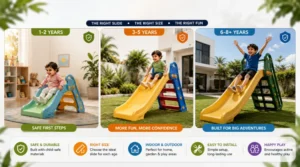
How to Choose a Kids’ Slide Based on Your Child’s Age
Age is a useful starting point when choosing a slide, but it is not the only thing to consider. Children of the same age can differ in height, weight, balance, and confidence. A good choice should suit the child and the space where the slide will be installed.
Best Toddlers Slide by Size
For children around 1 to 2 years old, a low and compact toddler slide or swing and slide set is usually a better choice. A toddler slide with an attached swing can be a good option for families who want more than one play activity while keeping the equipment suitable for toddlers.
For children around 2 to 3 years old, you can consider a slightly larger toddler or small children’s slide. Some models still have two or three steps, while others have a higher platform. The right option depends on the child’s size and how confidently they can climb and slide.
The number of steps alone does not decide whether a slide is suitable. Platform height, slide length, slope, step height, and weight capacity all work together. A longer slide may have a different platform height than a shorter one, even when both are made for a similar age group.
Weight is also important. Always check the manufacturer’s recommended weight limit before choosing a toddler slide. A child who is heavier or taller than average may need a different model, even if their age falls within the recommended range.
For toddlers, look for:
- A low platform that is easy to reach
- Wide and stable steps
- Easy-to-hold handrails
- A gentle slide angle
- A smooth and comfortable slide surface
- A stable base that does not move during use
- A clear area at the bottom of the slide
Adult supervision is still important, especially for younger children. Being able to climb the steps does not always mean a child is ready for a taller slide. A small slide for toddlers should allow them to climb, sit, slide, and stop without feeling overwhelmed.
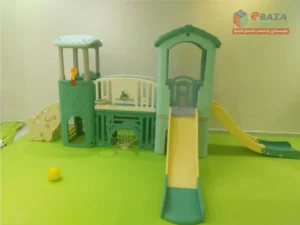
We installed something similar to this in a nursery in Riyadh an indoor toddler slide with a low, wide platform and soft flooring underneath. See how we set it up.
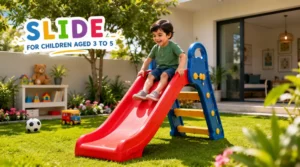
Choosing a Slide for Children Aged 3 to 5
Children between 3 and 5 years often become more confident with climbing and sliding. They may be ready for a slide with a slightly higher platform and a longer sliding surface. At this stage, stability becomes especially important. Look for strong steps, secure handrails, and a platform that does not wobble when the child climbs onto it.
The child’s height and weight should still be checked against the manufacturer’s recommendations. A taller child may be comfortable with a larger slide, while a smaller child of the same age may be better suited to a lower model. Don’t forget the space in front of the slide. A longer slide needs enough room for the child to come to a comfortable stop without hitting a wall, fence, furniture, or another piece of play equipment.
Slides for Children Aged 5 and Above
Children aged 5 and above can generally move on to larger outdoor kids’ slide when the equipment matches their height, weight, confidence, and ability. At this age, they may also enjoy different slide designs, such as spiral slides, tunnel slides, wave slides, and longer straight slides. These designs can offer a more exciting experience while still being made for the physical abilities of older children.
The size and design of the slide should still match the manufacturer’s recommended age and weight range. Larger slides usually have higher platforms, longer sliding surfaces, and stronger supporting structures to handle regular use by bigger children.
If several children will use the playground, check the maximum weight capacity and the manufacturer’s guidance on the number of users. A slide designed for one child at a time should not be used by several children together just because there is enough space. You should also look at the full installation area. Larger and longer slides need more room around the structure and a clear area at the exit.
The simple rule is to choose the slide according to the child’s size and ability, not age alone. Age gives you a starting point, while height, weight, confidence, slide design, and available space help you make the right choice.
Here’s one we set up for a family in Riyadh — a multi-lane slide with a swing set and roundabout in the same backyard. Take a look at residential playground installed.

How Much Space Do You Need for a Home Playground Slide?
A kids slide can look small in a product photo but take up much more room once it is installed. This is especially important in Saudi villas, apartments, and smaller backyard play areas, where every metre may already be in use. Before choosing a playground slide, measure the area where you plan to install it. Do not rely only on the product’s listed length and width. You also need enough room for children to climb, slide down, and move around the equipment safely.
Measure the Area Before Buying
Start by checking these three measurements:
- Available width
Measure the full width of the space where the slide and climbing section will stand. Leave room around the equipment rather than placing it directly against a wall or fence. - Available height
Check the height of the room or outdoor area, especially if you are installing the slide indoors or under a covered structure. Make sure there is enough space above the platform for children to climb without hitting a ceiling, beam, roof, or light fixture. - Forward landing space
This is the clear area in front of the slide exit. Children need enough room to slow down and get off the slide without running into a wall, plant pot, fence, furniture, or another piece of playground equipment.
Also measure the full footprint of the slide, including its steps and platform. A product may be listed as a certain length, but the stairs and climbing section can extend the total space needed.
Before installation, look around the area for:
- Walls and fences
- Trees and low branches
- Garden furniture
- Doors and gates
- Walkways
- Other playground equipment
- Electrical or lighting fixtures
- Vehicle parking or driving areas
This simple check can prevent a common mistake: buying a slide that fits on paper but does not work well in the actual space.
How Much Clearance Should Be Around a Children’s Slide?
There is no single clearance number that works for every slide. The required space depends on the slide’s design, height, length, manufacturer instructions, and installation layout.
The area around the climbing section should remain clear so children can get on and off the equipment without bumping into nearby objects. The same applies to the slide exit. Keep this area open and free from anything that could cause a child to trip or collide with an object.
Avoid placing a home slide next to sharp edges, hard obstacles, vehicle areas, or busy walkways. If the slide is part of a larger backyard playground, leave enough room for children to move between the different activities without crossing directly through the slide’s exit path.
For a backyard slide, think beyond the equipment itself. Measure the slide, the climbing area, the exit zone, and the surrounding space together. Then compare those measurements with the manufacturer’s installation requirements. This approach is particularly useful for Saudi homes, where a slide may be installed in a villa backyard, rooftop play area, indoor playroom, or a compact residential space.
Not sure whether your space is suitable for a home slide or complete play area? Ebaza Gardens can help. With hands-on experience in planning and installing playground spaces, our team can assess your available area and suggest a layout that makes practical use of the space. Get a quote from Ebaza Gardens and let our team help you plan it.
What Makes a Home Slide Safe for Children?
Choosing the right size is only one part of creating a safe home play area. The slide should also be stable, easy to use, and installed on a suitable surface. Before buying, check the complete structure rather than looking at the slide itself.
Check the Platform, Steps, Handrails and Slide Exit
Start with the steps and climbing area. They should feel stable when a child climbs up and should not move or wobble under normal use. Steps should also provide enough grip to help prevent slipping.
Handrails should be easy for children to hold. Their position should help the child stay balanced while climbing onto the platform.
The platform should remain firm when the child sits down and prepares to slide. Depending on the design, access may be open or partly enclosed. What matters is that the child can reach the slide without unnecessary gaps or unstable areas. Run your hand over the slide surface before installation. It should be smooth, with no sharp edges, rough sections, exposed screws, or other parts that could scratch or catch clothing.
The slide exit also needs attention. Children should have a clear place to come off the slide without immediately meeting a wall, fence, plant pot, furniture, or another piece of equipment. Finally, check the manufacturer’s installation instructions and recommended age and weight limits. Correct assembly is just as important as the quality of the equipment.
Choose the Right Playground Surface Under the Slide
The ground beneath and around a slide deserves the same attention as the equipment. A fall onto concrete, tiles, or other hard surfaces can be much more serious than a fall onto a suitable impact-absorbing playground surface.
Common options include rubber tiles, rubber flooring, and poured-in-place rubber surfaces. The right choice depends on the equipment height, installation area, drainage, maintenance needs, and the manufacturer’s or applicable safety requirements. Rubber playground flooring can provide a more forgiving surface around play equipment and can also give children better grip than smooth hard flooring.
For a home playground, think about the slide and its ground surface as one setup. If you’re planning a complete backyard play area, choose the slide and safety surfacing together rather than treating the ground as an afterthought. The right surface can make a big difference when children are playing around a slide. If you’re comparing options, our guide to rubber playground flooring explains the different types, safety features, and costs to consider.
Which Material Is Best for Outdoor Slides in Saudi Arabia?
Outdoor slides in Saudi Arabia face strong sunlight, high temperatures, dust, and regular outdoor use. That makes material quality an important part of choosing a slide, especially for villas, schools, parks, and residential play areas.
Plastic Slides for Hot and Sunny Outdoor Areas
Good-quality plastic is smooth, strong, and made for outdoor use. UV-resistant LLDPE is one option used in playground equipment because it can handle regular sunlight better than lower-quality plastics. It also provides a smooth surface for children to slide on.
Poor-quality plastic may fade, become brittle, or lose its appearance after prolonged exposure to harsh weather. When checking a slide, look for information about UV resistance, outdoor durability, and the quality of the plastic rather than choosing only by colour or design.
What to Look for in the Slide Structure
The supporting frame also needs to withstand outdoor conditions. Powder-coated steel is commonly used because the coating helps protect the metal from moisture and corrosion. Check that the joints are secure, the structure feels stable, and the finish is suitable for outdoor use. Proper installation is equally important. Even a well-made slide can become unstable if it is not assembled and anchored correctly.
Does Saudi Arabia’s Heat Affect Playground Slides?
Yes. Strong sunlight and high temperatures can affect outdoor playground materials over time. For this reason, choose equipment with UV-resistant, weather-suitable materials and a sturdy structure designed for outdoor use. Material choice becomes even more important when playground equipment is exposed to Saudi Arabia’s heat and sunlight year after year. Our comparison of outdoor playground equipment materials in Saudi Arabia looks at how different materials perform in these conditions and what to consider before choosing one.
Home kids Slide Buying Checklist
Before choosing a home kids slide, take a few minutes to check the details that can easily be missed in product photos or short online listings. A quick review can help you avoid choosing equipment that looks good but does not suit your home or everyday use.
Check These Points Before Buying
- Age and weight recommendation: Make sure the slide is designed for your child’s age and weight.
- Material quality: Check whether the plastic and frame are suitable for regular outdoor use.
- UV protection: For outdoor installation, look for materials designed to handle strong sunlight.
- Stable construction: The slide should have a solid frame, secure joints, and a stable base.
- Steps and handrails: Make sure children can climb comfortably and hold the handrails securely.
- Smooth slide surface: Check for sharp edges, rough areas, exposed screws, or other finishing problems.
- Installation requirements: Read the manufacturer’s instructions before deciding where to install the equipment.
- Ground surface: Avoid placing playground equipment directly on hard concrete where possible. Consider a suitable impact-absorbing surface.
- Maintenance: Check how easy the slide is to clean and whether any parts need regular inspection.
- Warranty and support: A clear warranty and reliable after-sales support can be useful when investing in outdoor playground equipment.
Most importantly, don’t choose a slide based only on its colour, design, or price. Good playground equipment should combine suitable design, reliable construction, safe use, and materials that can handle the environment where it will be installed.
Let Ebaza Garden Help You Choose the Right Slide
Still not sure which slide is right for your child or home? You don’t have to figure it out alone. At Ebaza Garden Toys, we help families choose playground equipment based on their child’s age, the available space, and how they plan to use it.
From compact slides for younger children to larger outdoor playsets, we can help you compare suitable designs, materials, and options for your space. We also consider the demands of Saudi Arabia’s outdoor climate when recommending equipment.
Planning a complete play area? We can help you bring the slide, swings, play equipment, and suitable flooring together into one practical setup.
Have a specific space or slide in mind? Contact Ebaza Gardens today. Tell us your child’s age, the type of space you have, and what you are looking for. Our team can help you find an option that fits your needs without making the choice more complicated than it needs to be.
A Better Slide Choice Starts With Your Child
Choosing the right kids slides for home starts with one simple question: Is it right for your child’s age? A slide that is too small may not keep an older child interested, while a slide that is too large or demanding may not suit a younger child. When the equipment matches a child’s age, energy, confidence, and ability, they are more likely to use it comfortably and actually enjoy playing on it.
As children grow, their play needs change too. That means slide height, length, design, steps, slope, and weight capacity should be considered according to their age and physical development. Safety also changes with the type of equipment, so features such as stable platforms, secure handrails, smooth surfaces, clear exit areas, and suitable playground flooring should never be overlooked.
For families in Saudi Arabia, the choice goes one step further. Outdoor slides should also be made from materials that can handle strong sunlight, high temperatures, and regular outdoor use. The right slide is therefore not simply the biggest, smallest, or most attractive one. It is the one that matches your child’s age and abilities, gives them the right level of challenge, and provides a comfortable and safer way to enjoy active play at home.
FAQS
What size slide is right for a 2-year-old?
A low toddler slide with a gentle slope, wide steps, and secure handrails is usually the best choice. Always check the manufacturer’s recommended age and weight limit before buying.
Should I choose a slide or a swing and slide set?
A single slide is a good choice for smaller spaces. If you have more room and want extra play activities, a swing and slide set can provide more fun while still matching your child’s age and ability.
How do I choose the right slide for my child?
Choose a slide based on your child’s age, height, weight, and confidence. Also consider the available space, safety features, and the manufacturer’s recommendations.
Can a plastic slide stay outside in Saudi Arabia?
Yes, if it is made from high-quality UV-resistant plastic designed for outdoor use. Good-quality materials are better able to withstand Saudi Arabia’s strong sunlight and high temperatures.
How much space do I need for a slide?
The space depends on the slide’s size and design. Leave enough room around the slide for safe climbing, sliding, and getting off the equipment, and always follow the manufacturer’s installation guidelines.
Which is better: a plastic or metal slide?
Both can be good choices when made from quality materials. Plastic slides are smooth and comfortable for children, while metal frames provide strong support. Choose a slide designed for outdoor use and your local climate.
What is the safest surface under a slide?
Rubber playground flooring, rubber tiles, or other impact-absorbing surfaces are safer than concrete or other hard surfaces. Choose a surface suitable for the slide and installation area.