.png)

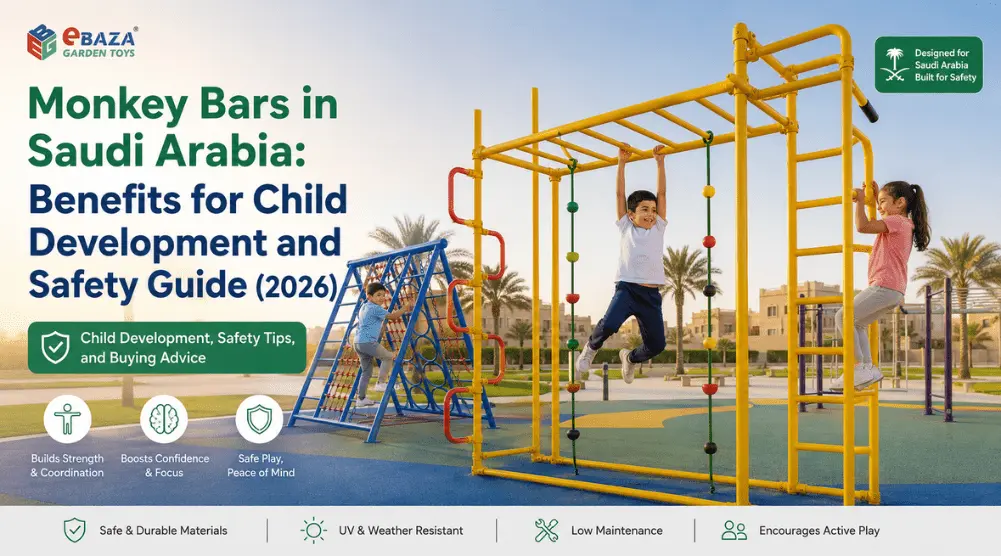
Monkey Bars in Saudi Arabia: Benefits for Child Development and Safety Guide (2026)
Monkey bars in Saudi Arabia are outdoor climbing equipment designed to help children develop strength, grip, balance, coordination, and confidence through active play. They can be used in school playgrounds, nurseries, villas, residential compounds, parks, and other outdoor play areas when the equipment is suitable for the children using it.
Choosing outdoor monkey bars for a Saudi playground involves more than selecting a design that looks attractive. The local climate also matters. High temperatures, strong sunlight, dust, and coastal humidity can affect playground equipment, safety surfacing, and long-term maintenance.
This guide covers the suitable age groups, developmental benefits, safety considerations, types of kids monkey bars, options for different playground locations, buying factors, and maintenance requirements. It is intended to help parents, schools, contractors, and playground project owners make a more informed choice.
At Ebaza Gardens, we supply and install commercial monkey bars for schools, parks, villas, nurseries, and residential compounds across Saudi Arabia. Our team helps clients choose equipment based on the children’s age, available space, safety requirements, and local weather conditions rather than simply selecting the biggest playground structure.
What Age Are Monkey Bar Sets Suitable For?
Best age for monkey bars: 6–12 years. Children in this range have the grip strength, coordination, and body awareness to use standard monkey bars safely. Toddlers under 3 should avoid them entirely; preschoolers (3–5) need shorter, lower bars.
Toddlers (Under 3 Years)
Standard monkey bars are not suitable for toddlers. Their grip strength and upper body muscles are still developing, making it difficult to safely hang or move across overhead bars.Low climbing structures, toddler climbing frames, gentle ramps, and low play equipment are much safer alternatives.
Preschool Children (3–5 Years)
Some children aged four or five may be ready for beginner monkey bars, but only if the equipment is designed for their age. Lower climbing bars with shorter reach distances help children build strength and coordination without unnecessary risk. Safe surfacing and close supervision remain essential because children at this age often overestimate their abilities.
Primary School Children (6–12 Years)
This is the age when most children benefit the most from monkey bars. Their improved strength and coordination allow them to climb more confidently while developing grip strength, balance, and gross motor skills. Playground equipment should be securely installed, regularly inspected, and placed over certified safety surfacing to minimise the risk of injuries.
Older Children (12+ Years)
Older children often need larger and more challenging climbing structures rather than standard playground monkey bars. Fitness-style monkey bars or advanced climbing frames provide a better challenge while supporting continued physical development. Even for older users, regular maintenance, secure anchoring, and safe fall zones remain just as important.
The best monkey bars are not the tallest or most challenging—they are the ones that match a child’s age, physical ability, and the intended playground environment. Choosing age-appropriate equipment helps children develop confidence while keeping outdoor play as safe as possible.
| Age Group | Recommended Bar Height | Bar Spacing | Surfacing Required |
|---|---|---|---|
| Under 3 | Not recommended | — | N/A |
| 3–5 years | Low (per EN 1176) | Short reach | EPDM/rubber, mandatory |
| 6–12 years | Standard | Standard | EPDM/rubber, mandatory |
| 12+ years | Fitness-grade | Wider | EPDM/rubber, mandatory |
How Climbing Frames Are Important for Child Development
Climbing frames offer much more than outdoor entertainment. Every movement, from hanging and swinging to reaching for the next bar, challenges different muscle groups and encourages children to coordinate their bodies in ways that many everyday activities cannot. When children use age-appropriate climbing equipment regularly and under proper supervision, they develop physical abilities, movement skills, and confidence that support healthy growth both on and off the playground.
Upper Body Strength
Unlike climbing stairs or running, monkey bars require children to support much of their own body weight using their arms, shoulders, chest, and back muscles. As children practise hanging and moving across the bars, these muscles become stronger and more coordinated. Improved upper body strength also supports everyday activities such as climbing, lifting, throwing, and maintaining better posture during play and sports.
Grip Strength
A secure grip is the foundation of safe climbing. Monkey bars naturally strengthen the muscles in the hands, fingers, wrists, and forearms because children must hold their body weight while moving from one bar to the next. Strong grip strength also helps children perform everyday tasks more comfortably, from holding sports equipment and writing tools to opening containers and carrying school bags.
Core Stability
Every swing across a climbing frame requires the abdominal and lower back muscles to work together to keep the body stable. A stronger core helps children control their movements instead of relying only on their arms. This improved stability supports better posture, balance, and body control during running, jumping, climbing, and other physical activities.
Balance and Coordination
Crossing monkey bars is not simply about strength. Children constantly adjust their body position, shift their weight, and coordinate movement to stay balanced while reaching for the next bar. This repeated practice improves overall coordination, making everyday activities such as cycling, jumping, climbing stairs, and participating in sports feel more natural and controlled.
Bilateral Coordination
Monkey bars encourage both sides of the body to work together in a coordinated sequence. As one hand releases a bar and the other reaches forward, the brain continuously processes timing, movement, and body position. This type of bilateral coordination supports many everyday skills, including catching a ball, swimming, dressing independently, and using tools that require both hands.
Gross Motor Skills
Gross motor skills involve the large muscle movements children use for climbing, jumping, running, and maintaining balance. Monkey bars strengthen these skills by combining multiple movements into a single activity rather than isolating one movement at a time. This helps children develop better body awareness, smoother movement patterns, and greater confidence during active play.
Confidence and Independence
Many children cannot cross an entire set of monkey bars on their first attempt, and that is part of the learning process. Every successful reach, longer hang, or completed crossing gives children a clear sense of progress. Over time, these small achievements build confidence, encourage independence, and motivate children to take on new physical challenges safely.
Problem Solving While Climbing
Monkey bars also challenge children’s thinking. Before moving forward, they instinctively judge the distance to the next bar, decide where to place their hands, and adjust their movements if they lose momentum. This constant cycle of observing, planning, and adapting helps strengthen problem-solving skills while encouraging children to think ahead during physical activity.
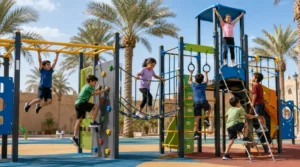
What are Kids Monkey Bar Safety Standards Every Playground Should Meet
Kids monkey bars are only as safe as their design, installation, and maintenance. Even high-quality equipment can become hazardous if it is installed incorrectly or inspected infrequently.
Whether you’re planning a school playground, a park, villa, or residential compound, these are the safety considerations you should never overlook.
Well-designed commercial playground equipment is often manufactured to internationally recognised standards such as ASTM F1487 or EN 1176, which cover equipment design, installation, and overall playground safety. While local project requirements may vary, these standards provide a reliable benchmark for safer playgrounds.
Proper Fall Height
The height of the monkey bars should always match the intended age group. Younger children need lower climbing equipment, while older children can safely use higher structures designed for their size and ability. Choosing the correct fall height helps reduce the severity of injuries if a child loses their grip.
Safety Clearance
Monkey bars need enough open space around them for children to climb, swing, and land safely. The safety zone should remain free from benches, walls, trees, fences, or other playground equipment that could create additional hazards during a fall.
Grip Diameter
The diameter of each bar should allow children to wrap their hands around it comfortably. Bars that are too thick can make it difficult for younger children to maintain a secure grip, while bars that are too thin may become uncomfortable during extended play.
Bar Spacing
The distance between bars should match the age group using the equipment. If the spacing is too wide, children may overreach and lose their balance. Proper spacing allows children to move naturally from one bar to the next without placing unnecessary strain on their shoulders or wrists.
Impact-Absorbing Playground Surfacing
The surface beneath monkey bars plays a critical role in reducing injuries. Materials such as EPDM rubber flooring, rubber safety tiles and mats, or engineered wood fiber, where appropriate, help cushion falls far better than concrete, asphalt, or compacted ground. The surfacing should also extend throughout the recommended fall zone. Many commercial playgrounds also use surfacing that complies with EN 1177, a standard that evaluates impact attenuation for playground safety surfaces. As a general guide, 40mm EPDM rubber is typically rated for fall heights up to 1.5m under EN 1177, with thicker tiles required for taller equipment.
Safe Installation
Even the strongest monkey bars are unsafe if they are not installed correctly. The frame should be securely anchored, level, and assembled according to the manufacturer’s recommendations.
Loose fittings, unstable foundations, or poor installation can compromise the safety of the entire structure.Professional installation should also follow the manufacturer’s instructions and any applicable playground safety standards, such as ASTM F1487 or EN 1176, where relevant.
Routine Inspections
Public and school playgrounds equipment should be inspected weekly; residential/villa installations every 1–2 months to identify loose bolts, worn coatings, corrosion, damaged welds, or other signs of wear before they become safety concerns. A simple maintenance routine helps extend the life of the equipment while keeping children safe during everyday use.
Heat Considerations in Saudi Arabia
Saudi Arabia’s climate requires additional attention. Metal surfaces can reach 55–70°C in direct Saudi summer sun, hot enough to cause skin burns within seconds, especially during summer afternoons. Installing monkey bars under shade structures, checking surface temperatures before use, and encouraging outdoor play during cooler morning or evening hours can significantly improve safety and comfort.
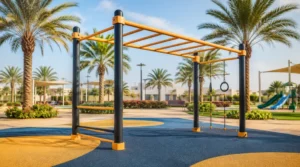
Different Types of Playground Monkey Bars for Outdoor Play Areas in Saudi Arabia
Playground Monkey bars are available in different designs to suit various playground projects. Some are ideal for helping children develop basic climbing skills, while others combine multiple activities to keep larger groups engaged. Understanding the purpose of each type makes it easier to choose equipment that matches your available space, budget, and the age of the children who will use it.
Steel Climbing Frame with Monkey Bars
A steel climbing frame with monkey bars is one of the most practical choices for schools, parks, and residential compounds where the equipment is expected to handle regular daily use. Its simple layout encourages children to climb, hang, and swing while developing upper body strength, grip, and coordination without unnecessary distractions. If you’re looking for a durable climbing structure that offers long-term reliability, this design is an excellent starting point.
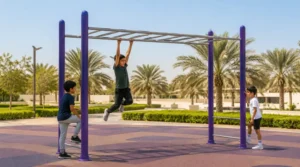
Multi-Activity Climbing Frame with Monkey Bars
When you want more than a standard climbing frame, a multi-activity design offers greater play value. By combining monkey bars with rope nets, climbing ladders, and other climbing elements, children can enjoy different challenges within a single structure. This type of playground equipment works particularly well for schools, public parks, and community playgrounds where children of different interests use the same play area throughout the day.
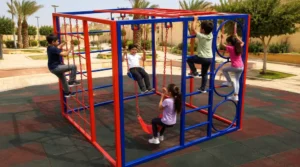
Double-Sided Playground Monkey Bars
Double-sided monkey bars are designed for busy playgrounds where several children play at the same time. Access from both sides improves playground flow, reduces waiting, and helps prevent crowding during peak play periods. This makes them a practical choice for schools, public parks, and large residential compounds where outdoor play areas receive frequent use.
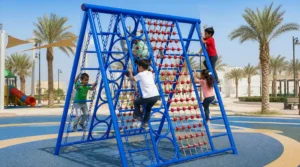
Climbing and Monkey Bar Set
A climbing and monkey bar set combines overhead bars with climbing ladders, ropes, and grip challenges to create a more varied play experience. Rather than repeating the same movement, children can climb, balance, and swing in different ways while building confidence and physical strength. This design is well suited to schools, villas, compounds, and parks looking to maximise play opportunities without installing multiple separate structures.
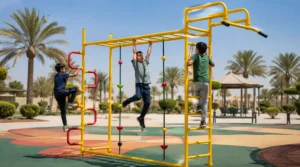
Choosing Outdoor Monkey Bars for Different Locations
Outdoor monkey bars should be selected according to where they will be used, not simply by their size or appearance. The number of users, age group, supervision level, and daily wear all influence which design will perform best over time. Choosing the right setup from the beginning improves safety, reduces maintenance, and provides better long-term value.
Monkey Bars for Villas
Villa playgrounds are built for everyday family use, so flexibility is often more valuable than complexity. Instead of choosing the tallest climbing frame, look for monkey bars that children can use confidently today while still offering enough challenge as they grow. A well-planned layout should also leave adequate space around the equipment, allowing children to climb, swing, and land safely without feeling confined.
climbing bars for Schools
School playgrounds experience concentrated use within short periods, especially during recess. For this reason, durability should never come at the expense of usability. Climbing bars should allow children to move comfortably without creating congestion or encouraging unsafe behaviour such as jumping ahead or climbing over one another. Selecting equipment based on the students’ age group and following a scheduled inspection programme helps maintain a safer playground throughout the academic year.
Monkey Bars for Nurseries
Nursery playgrounds need equipment that is easy to supervise and suited to the way younger children use outdoor play areas. Choose a structure designed specifically for the intended age group, with simple access points, clear visibility from the supervision area, and enough open space around the equipment. Safe impact-absorbing surfacing is also important because younger children may still be developing their balance and movement control.
For nurseries in Saudi Arabia, shade and heat management should also be considered when planning the play area. A well-planned layout gives caregivers a clear view of the equipment while giving children enough room to move without crowding.
Monkey bar equipment for Parks
Monkey bar equipment in public parks should accommodate a wider range of users than those in private play areas. The design should encourage smooth movement through the play space while allowing several children to use the equipment without interfering with one another. Materials that resist corrosion, fading, and heavy wear are particularly important because public equipment remains exposed to constant use and changing weather conditions.
Monkey Bars for Residential Compounds
Residential compounds usually have shared playgrounds used by several families, so the layout needs to handle regular use without creating congestion. Monkey bars for kids can be combined with other climbing and play equipment to give children different activities within the same area.
For compound projects, consider the number of expected users, available space, shade, safety surfacing, and ease of maintenance. A well-planned layout also makes it easier for parents and caregivers to supervise children from nearby seating or walking areas.
Monkey Bars for Public Playgrounds
Public playgrounds demand equipment that continues to perform safely despite frequent use by large numbers of children. Selecting monkey bars with a durable structural frame, secure anchoring, and replaceable components can significantly reduce long-term maintenance costs. Equally important is maintaining clear fall zones, installing EPDM rubber flooring of adequate thickness for the equipment’s fall height (typically 40mm for fall heights up to 1.5m, with thicker tiles required for taller structures, per EN 1177), and following a regular inspection schedule so that minor wear is addressed before it develops into a safety issue.
Choosing the right monkey bars is easier when you consider the project as a whole, including the available space, children’s age, safety requirements, and expected daily use. At Ebaza Gardens we work with clients across Saudi Arabia to recommend playground equipment that suits each project’s needs rather than offering a one-size-fits-all solution. If you’re looking for ideas or want to see how different playgrounds have been designed, browse our completed playground projects across Saudi Arabia.
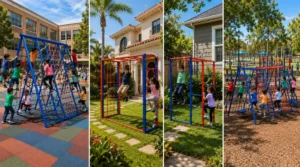
How to Choose the Right Monkey Bars Before Buying
Choosing monkey bars equipment should not start with colour or price. The first question is simple: who will use them, and where will they be installed? A small home garden, a school playground, and a public park all need different levels of strength, height, flooring, and safety space. Good outdoor monkey bars should feel safe, stable, and comfortable for children to use. They should also handle outdoor weather, especially in Saudi Arabia where heat, sun, dust, and humidity can affect weak materials quickly.
Buyer Checklist for Parents, Schools, and Contractors
- Measure the available area before choosing the size: Leave enough room around the equipment, not only under it.
- Confirm the clear safety zone: Monkey bars should not be too close to walls, trees, glass doors, benches, swings, or parking areas.
- Choose galvanized steel or heavy-duty outdoor material: for better strength and longer life.
- Ask about powder coating and rust protection: especially for outdoor use in Riyadh, Jeddah, Dammam, and coastal areas.
- Match the fall height with proper safety flooring: Match the fall height with suitable impact-absorbing surfacing.
- Check bar spacing and grip comfort: Bars should not be too far apart or too thick for children’s hands.
- Avoid sharp edges, weak joints, exposed bolts, or rough welding.
- Confirm the installation method and ground anchoring: A strong frame still needs proper fixing.
- Ask about maintenance support and spare parts.
- For schools, compounds, and large projects, request a 2D or 3D layout before final order: This helps place the monkey bars safely with the right flooring, shade, and play flow.
Ask whether the equipment has been designed or tested in accordance with recognised playground safety standards, such as ASTM F1487 or EN 1176, where applicable.
If you’re unsure which monkey bar design is right for your project, Ebaza Gardens can help you compare different options based on your available space, budget, and the age of the children who will use the playground. Getting expert advice before ordering often helps avoid costly changes later.
Monkey Bars Maintenance Tips for Saudi Climate
Monkey bars in Saudi Arabia need regular care because outdoor conditions can be harsh. Heat, dust, strong sun, and humidity in coastal cities can slowly affect the frame, coating, bolts, and flooring. Start by checking the bolts and ground anchors. If the frame moves, shakes, or makes noise during use, stop children from using it until it is fixed. Also look for rust spots, especially near joints, welds, and base plates.
Dust should be cleaned from the bars often. A dusty grip can make children’s hands slip, especially when they are swinging or moving from one bar to another. The powder coating should also be checked. If paint starts peeling or cracking, repair it early before rust spreads. The flooring matters too. Rubber tiles or EPDM flooring should stay level, soft, and firmly fixed. Loose edges, cracks, or hard spots under monkey bars should not be ignored.
For schools, compounds, and public playgrounds, schedule deeper inspections because more children use the equipment every day. Broken parts should never be left open for children to use.
Simple Monthly Inspection Checklist
• Are all bars firm?
• Are bolts covered and tight?
• Is the frame stable?
• Is the flooring soft and level?
• Is there any rust, crack, or peeling paint?
• Is the fall zone clear?
• Are children using it according to age and rules?
Monkey Bars by Region: Climate Considerations Across Saudi Arabia
Saudi Arabia isn’t one climate it’s several. A monkey bar set that holds up perfectly in Riyadh’s dry heat can rust within a couple of years on the coast in Jeddah or Dammam, and vice versa. The two biggest regional threats are heat and dust inland, and humidity and salt air near the coast, so the right material choice really does depend on where the playground sits.
| Region | Main Climate Risk | What It Means for Monkey Bars |
| Riyadh & Central Region | Extreme dry heat, intense UV, sand and dust | Faster coating fade, hotter metal surfaces, more frequent dust cleaning |
| Jeddah, Dammam & Coastal Cities | High humidity, salt air, moisture | Faster corrosion, rust around joints and bolts, coating breakdown near the coast |
Riyadh and Central Saudi Arabia: Dry Heat, UV, and Dust
If you’re installing monkey bars in Riyadh, Qassim, or anywhere inland, heat and sun exposure are the main things to plan for, not moisture. Metal bars left in direct sun here can get hot enough to burn skin within seconds during summer afternoons, which is exactly why shade structures matter more in this region than almost anywhere else in the country.
Dust is the other issue. Fine sand works its way into bolts, joints, and painted surfaces over time, and a dusty bar grip is a genuine slip risk for kids mid-swing. UV exposure also fades powder coating faster here than in more humid areas, so touch-up painting tends to come around sooner.
What actually helps in Riyadh and inland areas:
- Install shade sails or canopy structures over the play area, not just nearby
- Wipe down bars more often during dusty months — weekly is reasonable for schools and public playgrounds
- Choose UV-resistant powder coating rated for high sun exposure
- Schedule play for early morning or evening during peak summer
Jeddah, Dammam, and the Coast: Humidity, Salt Air, and Corrosion
Coastal cities flip the priority list. Heat is still a factor, but salt-laden humid air is what actually shortens a playground’s lifespan here. Salt air speeds up corrosion, especially around bolts, welds, and any spot where the coating has even a small chip or scratch. Once rust starts at a joint, it spreads faster in humid coastal air than it would inland.
This is why the same monkey bar set that lasts 8-10 years in Riyadh might need major maintenance in half that time on the coast if it wasn’t built for salt exposure from day one.
What actually helps in Jeddah, Dammam, and coastal areas:
- Choose hot-dip galvanized steel, not just standard powder-coated steel — galvanizing resists salt corrosion far better
- Inspect bolts, welds, and base plates more frequently, since these are where rust starts first
- Repair any coating chip or scratch immediately, before rust can take hold underneath
- Ask your supplier specifically whether the coating is rated for coastal/marine conditions
Safe Monkey Bars Can Turn a Simple Play Area Into a Stronger Development Space
Choosing monkey bars in Saudi Arbia for a playground is not only about finding a structure that looks fun. The right equipment should suit the children who will use it, fit the available space, and be installed with appropriate safety surfacing and fall protection.
For playgrounds in Saudi Arabia, outdoor conditions also matter. Strong sunlight, heat, dust, and coastal humidity can affect playground equipment over time, so durable materials, suitable protective finishes, secure installation, and regular maintenance are important for long-term use.
Whether you are planning a villa playground, school, nursery, residential compound, park, or public play area, choosing age appropriate monkey bars and planning the surrounding space properly can create a more useful and enjoyable outdoor play environment. If you need help selecting monkey bars for a project in Saudi Arabia, contact Ebaza Gardens our team can help you compare suitable options based on the children’s age, available space, playground requirements, and intended use.
FAQs
1. How old should a kid be for monkey bars?
Most children are ready for standard monkey bars between ages 6 and 12, once they have enough grip strength and coordination to support their own body weight. Kids aged 3 to 5 can start with beginner-level, lower bars with shorter reach distances, while children under 3 should stick to low climbing frames instead. Age is a starting point, not a fixed rule. A child’s confidence and upper-body strength matter just as much, so always let ability guide the decision, not just birthdays.
2. How Monkey Bars Improve Children’s Development?
Monkey bars play an important role in a child’s physical development by strengthening the upper body, improving grip strength, enhancing balance and coordination, and developing gross motor skills. They also help build confidence, encourage problem-solving, and promote active outdoor play. When children use age-appropriate monkey bars with proper supervision and safety surfacing, they can enjoy these developmental benefits while reducing the risk of injury.
3. Why do kids like monkey bars?
Kids are drawn to monkey bars because they offer an immediate, visible challenge — hang, swing, reach, repeat. Every crossing feels like a small win, which is exactly why children keep coming back to try again even after falling short the first few times. That mix of physical challenge, quick feedback, and bragging rights (“I made it all the way across!”) makes monkey bars one of the most repeated activities on any playground.
4. Can I Install Monkey Bars at Home?
Yes. Monkey bars are suitable for home gardens and backyards if there is enough space, proper safety flooring, and secure installation.
5. What safety flooring should be installed under monkey bars?
EPDM rubber flooring, rubber safety tiles, and other certified impact-absorbing surfaces are recommended because they help reduce the risk of injuries from falls compared to concrete or hard ground.
6. How much space is required around monkey bars?
Monkey bars need adequate safety clearance on all sides to allow children to climb, swing, and land safely. The required space depends on the equipment size, fall height, and applicable playground safety standards.
7. How often should outdoor monkey bars be inspected?
Monkey bars should be inspected regularly for loose bolts, corrosion, damaged coatings, unstable foundations, worn components, and flooring condition. Schools and public playgrounds typically require more frequent inspections than residential installations.
8. Can monkey bars stay outdoors all year in Saudi Arabia?
Yes. High-quality outdoor monkey bars built from weather-resistant materials such as galvanized steel with powder coating are designed to withstand Saudi Arabia’s heat, sun, dust, and coastal humidity when properly maintained.
9. What makes monkey bars more safe and easy to use?
Monkey bars become safer and easier to use when the bar diameter fits a child’s hand, the spacing between bars matches their reach, and the whole structure sits over proper impact-absorbing flooring like EPDM rubber. Secure anchoring, rounded edges, and age-appropriate fall height also make a big difference in both safety and ease of use. In short: it’s not the bars themselves that make them safe — it’s how well the entire setup is matched to the child using it.
10. Do monkey bars require professional installation?
For schools, parks, residential compounds, and other commercial playgrounds, professional installation is strongly recommended to ensure proper anchoring, safe fall zones, and compliance with recognised playground safety standards.
11. Can Monkey Bars Be Used by Multiple Children?
Yes. Commercial monkey bars are designed to accommodate multiple children at the same time, provided there is enough space and the equipment is used according to its intended capacity and age group. Supervision helps ensure safe play.