.png)

A Guide to Choosing a Safe Kids Trampoline: Sizes, Safety Nets, and Installation in Saudi Arabia
Choosing a safe kids trampoline in Saudi Arabia means checking the size, the safety net, and how it’s installed, since these three things decide whether it holds up in outdoor heat and daily use. Get any one of them wrong, and problems show up fast — a trampoline that’s too big or too small for the space, a frame that’s not strong enough, or a net that stretches and sags after one summer.
Kids don’t jump carefully. They jump hard, land off-centre, and push the trampoline to its limits every single day. That’s usually when weak points show up, not months later. Heat and dust make this worse. Strong sun breaks down cheap padding. Dust works into the springs and loosens them over time. A kids trampoline that isn’t built for these conditions won’t stay safe for long, no matter how good it looked on delivery day.
This guide covers what actually matters: picking the right size for your space, choosing a safety net that won’t fail, and installing it the right way for Saudi weather and ground conditions.
What Makes a Safe Kids Trampoline?
A safe kids trampoline comes down to six things: a strong frame, a solid safety net, durable springs, thick padding, the right weight capacity, and UV-resistant materials. Get these right and you’ve covered most of what actually causes accidents or early wear.
Strong and Durable Frame
The frame is the foundation of the trampoline. A high-quality frame made from galvanized steel offers better strength and resists rust more effectively than ordinary painted steel. Look for thick steel tubing, reinforced joints, and a stable leg design that keeps the trampoline balanced during active play.
Full Enclosure Safety Net
A safety net keeps kids inside the jump zone when they land off-balance. Look for tightly woven mesh, strong support poles, and a zipper or clip entry that won’t loosen with daily use. A good net stays tight for years, not just the first few months.
High-Quality Springs
The springs control how the trampoline performs. Strong galvanized springs provide smoother bouncing and maintain their tension longer. Springs should be evenly spaced and fully covered with protective padding to prevent accidental contact while children are jumping.
Thick Protective Padding
Padding covers the springs and frame to reduce the risk of injury. Good-quality padding should be thick, securely attached, and made from weather-resistant materials that can handle strong sunlight without cracking or wearing out quickly.
Suitable Weight Capacity
Every trampoline is designed to support a maximum user weight. Always choose a model that matches the age and combined weight of the children who will use it. Exceeding the recommended weight limit places extra stress on the frame, springs, and jumping mat, reducing both safety and product lifespan.
UV-Resistant Outdoor Materials
Saudi Arabia’s intense sunlight can quickly damage low-quality materials. Choose a trampoline with a UV-resistant jumping mat, weather-resistant padding, and durable enclosure netting designed for outdoor use. These materials help reduce fading, cracking, and premature wear, allowing the trampoline to stay safer and last longer.
Buyer Tip: Don’t compare trampolines based only on size or price. A well-built trampoline with a strong frame, quality safety features, and outdoor-rated materials usually provides better value and a safer play experience than a larger, lower-quality model.
Safe Kids Trampoline Features: Quick Reference
If you’re comparing different frame and plastic options, our guide on playground material comparison explains how galvanized steel, powder coating, HDPE, and LLDPE perform in Saudi Arabia’s outdoor conditions.
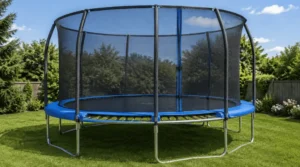
Safe Kids Trampoline Features: What to Compare Before You Buy
| Feature | What to Look For | Why It Matters |
| Frame | Galvanized steel with reinforced joints | Improves stability and resists rust in outdoor conditions |
| Safety Net | Full enclosure with strong support poles | Helps prevent falls while children are jumping |
| Springs | Galvanized, evenly spaced, and fully covered | Provides smoother bouncing and reduces injury risks |
| Padding | Thick, UV-resistant spring padding | Protects children from exposed springs and hard edges |
| Weight Capacity | Suitable for your child’s age and weight | Prevents excessive stress on the trampoline |
| Jumping Mat | UV-resistant, heavy-duty material | Lasts longer in Saudi Arabia’s harsh sunlight |
| Warranty | Manufacturer’s warranty and spare parts availability | Gives added confidence and easier long-term maintenance |
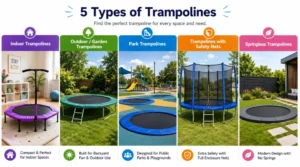
Types of Trampolines Available in Saudi Arabia
Trampolines come in different types depending on where and how they are used.
Indoor trampolines are small and made for inside spaces. Best for younger kids and limited room.
Outdoor trampolines / Garden trampolines are the most common in Saudi homes. They are larger, stronger, and built to handle heat, dust, and direct sunlight. These are what most families install in backyards.
Park trampolines are what you see in public play areas or trampoline parks. They are heavy-duty, fixed setups made for high usage. Not for home use.
Trampolines with safety nets are designed for safer home use. The net keeps kids inside the jumping area and reduces fall risks.
Springless trampolines replace metal springs with elastic bands. Less impact and fewer injury risks.
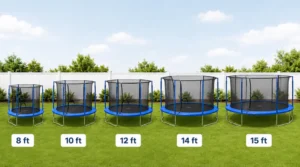
How to Choose the Right Trampoline Size
Choosing the right trampoline size is not random. It depends on age, space, and how often it will be used. In Saudi homes, most people go for medium to large outdoor setups because backyards usually allow more space. But the wrong size can cause trouble fast. Too small feels useless. Too big becomes unsafe if the area around it is tight.
8FT trampoline is the smallest common size. It works for toddlers or very young kids. Keep it in small courtyards or limited garden spaces. Not for multiple kids at once.
10FT trampoline is a step up. Best for young kids who just started active jumping. It fits small to medium backyards and gives slightly more movement space without taking over the whole yard.
12FT trampoline is the most common family choice. Kids use it daily, sometimes even adults for light use. It needs a proper garden area with clear space around it. This size feels balanced.
14FT trampoline is for bigger families or older kids. More jumping space means less collision risk when multiple children play together. It needs a wide backyard and proper safety clearance.
15FT trampoline is the largest home size. It can handle teenagers and even adults comfortably. But it takes serious space. You don’t install this in a small garden. It needs open ground and strong anchoring because wind and movement load increase with size.
The thing is simple. Bigger isn’t always better. The safe choice is the one that fits your space with extra clearance on all sides.
Trampoline size selection depends on user age, available space, and usage level. Smaller sizes like 8FT and 10FT are suitable for toddlers and young children, while 12FT is ideal for general family use. Larger sizes such as 14FT and 15FT support older kids, teenagers, and even adults but require significantly more installation space and safety clearance.
| Trampoline Size | Suitable Age Group | Usage Type | Installation Area | Approx. Space Required |
| 8FT | Toddlers / small kids | Light play | Small courtyard / compact garden | ~10–12 FT clearance |
| 10FT | Young kids | Casual use | Small to medium backyard | ~12–14 FT clearance |
| 12FT | Kids / family use | Regular use | Medium backyard | ~14–16 FT clearance |
| 14FT | Older kids | Heavy use | Large backyard | ~16–18 FT clearance |
| 15FT | Teens / adults | High use | Large open garden | ~18–20 FT clearance |
Why a Safety Net Is Essential for Every Trampoline
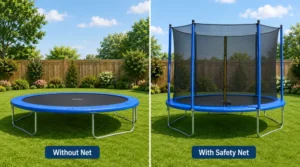
A trampoline safety net acts as a physical barrier that keeps jumpers contained within the mat area, reducing the risk of falls, sprains, fractures, and head injuries caused by landing on the ground or frame.
Key Reasons a Safety Net Is Essential
| Reason | Without Net | With Net |
|---|---|---|
| Fall prevention | Jumper can fall off edge | Jumper stays contained |
| Injury risk | Higher (ground/frame impact) | Significantly lower |
| Multiple jumpers | Collisions can push kids off | Net absorbs and redirects motion |
| Parental supervision | Requires constant watching | Reduces need for direct intervention |
| Confidence for kids | Hesitant, fearful jumping | Freer, safer play |
Who Needs It Most
- Children under 12 — less body control, higher fall risk
- Sometimes collisions between jumpers cause direct injury — and if a child falls off, or gets pushed by another in anger or excitement, injury from hitting the ground becomes just as obvious a risk.
- Backyards with hard surfaces — concrete, pavers, or rocky ground nearby
- Trampolines elevated off the ground — falls from height cause more severe injuries
A trampoline without a net offers open bounce space but no fall protection. A trampoline with a net controls the outcome of losing balance turning a potential injury into a harmless bounce back toward the center.
Spring vs Springless Trampolines: Which Is Better for Kids?
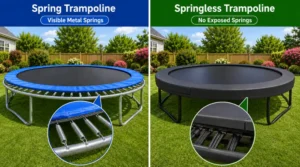
| Feature | Spring Trampoline | Springless Trampoline |
| Bounce | Higher and more responsive | Softer and more controlled |
| Safety | Safe with quality padding and enclosure | No exposed metal springs, reducing pinch risks |
| Maintenance | Springs may need replacement over time | Fewer moving parts to maintain |
| Price | Usually more affordable | Generally more expensive |
| Best For | Most families and everyday backyard use | Parents prioritising maximum safety and premium features |
Which should you choose?
Both types can be safe when they are made from high-quality materials and installed correctly. A well-built spring trampoline with thick padding, a strong enclosure net, and galvanized springs is suitable for most families who want strong bounce, reliable performance, and a more affordable option.
If your budget allows and you want to minimise the risk of contact with springs, a springless or called spring free trampoline offers an extra level of safety. Instead of focusing only on the design, compare the overall build quality, weight capacity, warranty, and safety features before making your decision.
What is a Safe Kids Trampoline Buying Checklist Before You Order?
Before you choose a trampoline, don’t rush it. Small mistakes here usually turn into safety issues or wasted money later.
- Measure your available space properly before ordering
- Check the child’s age and weight limit for the trampoline
- Choose a full enclosure safety net, not an open design
- Make sure springs, hooks, and frame edges are fully covered
- Look for UV-resistant material for strong outdoor sun in Saudi Arabia
- Check if spare parts are available for future repairs
- Check whether the supplier can help with safe delivery, setup, and proper trampoline placement before you buy
- Confirm warranty coverage and what it actually includes
- Decide the exact installation spot before delivery (garden, rooftop, backyard)
Before choosing a model, compare different trampoline sizes and match them with your space and usage needs.
If you’re still confused or comparing options, get a quote from Ebaza Gardens, a supplier and installer of indoor and outdoor playground equipment.
Safe Trampoline Setup Tips for Saudi Homes and Gardens
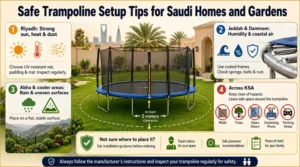
Safe trampoline installation in Saudi Arabia depends on matching the setup to local weather: UV-resistant materials for Riyadh’s heat, rust-resistant frames for Jeddah and Dammam’s humidity, and stable ground checks for Abha’s terrain. Getting this regional match right is what determines how long the trampoline stays safe to use.
In Jeddah and Dammam, humidity and coastal air can be harder on metal frames, springs, and bolts. A strong coated frame and proper maintenance help protect the trampoline from early rust or weakness.
For Abha and other cooler areas, outdoor exposure, rain periods, and uneven garden surfaces should be checked before installation. The trampoline should sit on a flat, stable surface with enough clear space around it.
Across KSA, avoid placing a trampoline near walls, trees, glass doors, swimming pools, or parking areas. If you are not sure where to place it, ask for installation guidance before ordering. It is easier to choose the right trampoline when the space is checked first.
How to Keep a Trampoline Safer for Longer
Check a trampoline’s net, mat, frame, springs, and padding once a month. Monthly inspection catches small wear before it turns into a safety hazard.
- Do a regular trampoline safety inspection of net, mat, frame, springs, and padding
- Check the net for tears, weak stitching, and broken or weak zippers
- Inspect the jumping mat for small cuts or thinning areas that can grow with use
- Look at the frame and legs for rust, loose bolts, or unstable balance
- Check springs for stretching, damage, or loss of tension
- Make sure padding is fully covering all metal edges with no cracks or gaps
- Clean dust and sand from the trampoline mat regularly, especially in outdoor areas
- Avoid placing heavy objects on the trampoline surface
- Do not use the trampoline during high wind or stormy weather
- Replace damaged parts immediately (net, springs, mat, or padding) before allowing kids to use it again
A trampoline is only safe when it stays in good condition.
Where Should You Place a Trampoline for Safe Play?
The safest trampoline placement is on flat, stable, well-drained ground with at least 1.5–2 metres of clearance on all sides, away from walls, trees, and pools. Even a high-quality trampoline becomes unsafe if it’s installed on the wrong surface or in the wrong spot.
- Choose flat, stable ground. A level surface keeps the trampoline balanced and reduces the risk of tipping during use.
- Avoid soft sand, loose soil, or steep slopes. These surfaces can shift over time, making the trampoline unstable.
- Keep at least 1.5–2 metres of clear space around the trampoline. Avoid placing it near walls, fences, trees, swimming pools, glass doors, or parked vehicles.
- Concrete surfaces require extra protection. If installing on concrete, place protective rubber mats beneath and around the trampoline and secure it properly to prevent movement.
- Artificial grass is suitable as long as the ground underneath is firm, level, and well-compacted. Check the surface regularly for uneven areas.
- Rubber safety flooring provides additional protection around the trampoline by helping cushion accidental falls when children get on or off.
- Avoid rooftop installation unless the structure is designed to support the load. Always ensure there is sufficient safety clearance and consult a professional if you are unsure.
- Anchor the trampoline securely, especially in windy areas. Ground anchor kits help prevent the frame from shifting or lifting during strong winds.
- Choose a well-drained location. Avoid areas where rainwater collects, as standing water can shorten the life of the frame, springs, and jumping mat.
- Place the trampoline where it receives partial shade when possible. Shade helps reduce surface temperatures and slows UV damage to the jumping mat, safety net, and protective padding.
- After assembly, tighten every bolt and connection and inspect the trampoline again after the first few days of use to ensure everything remains secure.
Installation Tip: A trampoline is only as safe as the surface beneath it. Choosing the right location, using proper anchoring, and checking stability regularly can significantly improve both safety and the lifespan of your trampoline in Saudi Arabia’s outdoor climate.
At What Age Should Kids Start Trampoline Jumping?
Children can safely start using a trampoline around age 6, and always with an adult watching. Before that age, a child’s bones and balance are still developing, so jumping too early raises the chance of sprains or falls.
If your child is younger and still wants to bounce, a small trampoline with a net and low height is the safer choice, and an adult should stay close the whole time.
Simple age breakdown:
- Below 3 years: Skip it for now
- 3 to 5 years: Only mini trampolines, adult must supervise
- 6 to 8 years: Full-size trampoline okay, but still needs supervision
- 9 years and up: Can jump on their own, safety net still a must
What are Common Mistakes to Avoid When Buying a Trampoline
The most common trampoline-buying mistakes are picking the wrong size, ignoring weight limits, skipping a quality safety net, and installing on uneven ground. These errors usually surface only after installation, once it’s harder and costlier to fix.
- Choosing the wrong size for the available space, leaving no safety clearance around it
- Ignoring weight limits and buying a light frame for heavy or multiple users
- Skipping the safety net or picking a low-quality net that loosens quickly
- Buying without checking frame strength and rust-resistant coating for outdoor use
- Overlooking UV resistance, which leads to fast material damage under strong sun
- Not checking spring quality, which affects bounce and long-term durability
- Forgetting about spare parts availability, making repairs difficult later
- Installing on uneven ground, which affects balance and increases tipping risk
- Not planning the exact location before delivery, causing relocation issues later
- Focusing only on price instead of safety and build quality
A trampoline should be treated as a long-term outdoor setup, not a cheap play item. The right choice depends on safety, durability, and proper installation more than anything else.
Need Help Choosing & Installing a Trampoline?
Ebaza Gardens makes the process simple. From selecting the right trampoline size to safe installation, everything is handled with real on-ground experience in indoor and outdoor playground setups.
Whether you have a small garden or a large outdoor space, the team helps you pick the right product, suitable materials, and safe placement for long-term use in Saudi conditions. They also handle full installation for homes, schools, and commercial play areas.
For space planning, product selection, material guidance, or any other query, contact Ebaza Gardens and get expert support for your playground setup.
Final Thoughts on Choosing a Safe Kids Trampoline
Choosing a safe kids trampoline comes down to three things: the right size for your space, a net that won’t fail, and correct installation. Get these right and the trampoline holds up to daily jumping and Saudi’s heat and dust for years. Skip regular checks on the net, mat, frame, and springs, and small wear turns into real risk fast. A trampoline picked with care, set up properly, and checked often is what keeps playtime safe.
FAQs
1. Can a trampoline stay outside all year in Saudi Arabia?
Yes, if it is designed for outdoor use with UV-resistant materials and a rust-resistant galvanized steel frame. Regular cleaning, periodic inspections, and using a weather cover when not in use can help extend its lifespan.
2. How much space should I leave around a trampoline?
Leave at least 1.5 to 2 metres of clear space around all sides. Keep the trampoline away from walls, fences, trees, swimming pools, and other hard obstacles to reduce the risk of accidents.
3. Is it safe for more than one child to jump on a trampoline at the same time?
For the safest experience, only one child should jump at a time. Multiple users increase the risk of collisions and unpredictable bouncing, even if the trampoline has a high weight capacity.
4. How often should a trampoline be inspected?
As a baseline, check the frame, springs, safety net, padding, and anchor points once a month. But in Riyadh’s summer heat and dust, once a month isn’t always enough — sun exposure ages padding and netting faster, and dust works into springs and joints quicker than most people expect. During peak summer, a quick visual check every 2–3 weeks catches wear before it becomes a real risk. If something looks worn or damaged, swap it out before the next jump, not after.
5. Does a more expensive trampoline always mean better quality?
Not always. Instead of focusing only on price, compare the frame material, safety features, spring quality, UV resistance, warranty, and replacement parts before making a decision.
6. How much does a kids trampoline cost in Saudi Arabia?
Kids trampolines in Saudi Arabia usually cost between 498 SAR and 5157 SAR at Ebaza Gardens, depending on size, shape, and safety features. See current Ebaza Gardens trampoline prices for exact models and sizes.
7. Can I install a trampoline on artificial grass?
Yes. Artificial grass is suitable if the ground underneath is level, firm, and well-compacted. Make sure the trampoline is properly anchored, especially in areas exposed to strong winds.
8. How long does a quality outdoor trampoline usually last?
A well-maintained trampoline can last 5 to 10 years or more, but in Saudi conditions the real deciding factor is heat and dust exposure, not just build quality. A trampoline left in direct sun with no shade or cover will show fading, cracking, and spring wear years earlier than one with partial shade and regular cleaning. Coastal setups in Jeddah or Dammam also need closer attention to frame rust from humidity.
9. What size trampoline should I buy?
The right trampoline size depends on your child’s age and how much space you have. Go with 8FT or 10FT for toddlers and young kids, 12FT for general family use, and 14FT or 15FT if you have older kids or a bigger backyard. Always leave extra clear space around it, no matter the size.
10. Is trampoline jumping safe for kids?
Trampoline jumping is safe for kids when there’s a safety net, adult supervision, and only one child jumping at a time. Most injuries happen from falls off the edge or from too many kids jumping together, not from the trampoline itself. Good equipment and basic rules fix most of the risk.