.png)

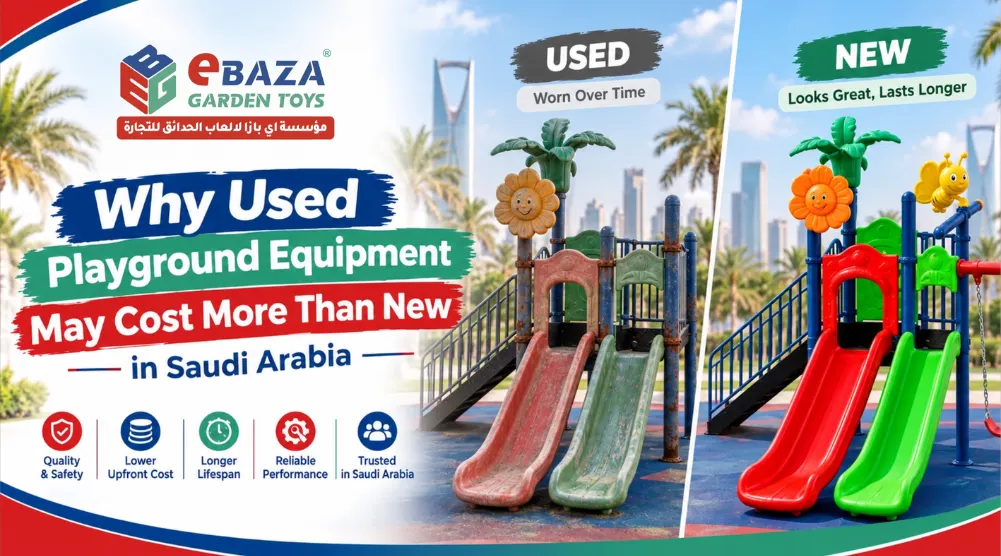
Why Used Playground Equipment May Cost More Than New in Saudi Arabia
A used playground can look like a good deal when you see the first price. Low cost. Ready structure. Quick decision. But after working around playground projects in Saudi Arabia, one thing becomes clear: used playground equipment may cost more than new in Saudi Arabia when the full installation cost is counted.
The problem is not always the play equipment itself. The problem starts after buying it. Dismantling, loading, transport, repainting, missing parts, weak bolts, old swing chains, damaged plastic slides, and new safety flooring can all increase the final budget. This is where many buyers get surprised, especially when they compare only the price of second-hand playground equipment with a new playset.
Saudi weather makes the decision even more serious. Heat, dust, humidity in coastal cities, and long outdoor exposure can affect metal frames, plastic panels, anchors, and moving parts. A playground that looks fine in photos may still need repair before it is safe for children.
This guide will help schools, nurseries, residential compounds, villa owners, contractors, and procurement teams understand the real playground installation cost in Saudi Arabia. You will learn where hidden costs come from, what to check before buying used equipment, and when new playground equipment becomes the safer and better long-term choice.
When a ‘Cheap’ Used Playground Ends Up Costing More
The sticker price on a used playground rarely tells the whole story. Once you factor in dismantling, transport, repainting, missing hardware, new safety flooring, and reinstallation, that ‘bargain’ price can climb fast sometimes past what a new system would have cost from the start.
Cost Factor |
Used Playground Equipment |
New Playground Equipment |
| Purchase Price | Usually lower at first | Higher at first |
| Dismantling | Often paid by the buyer | Not needed |
| Loading & Transport | Can be costly if the structure is large or far away | Planned from supplier warehouse or factory |
| Repair & Welding | Additional repair work may be necessary if any parts of the frame have weakened over time. | Generally requires minimal preparation before installation |
| Repainting or Powder Coating | Often needed to make the equipment look clean again | Already finished as part of production |
| Missing Parts | Bolts, caps, clamps, chains, panels, or anchors may be missing | Complete parts supplied with the system |
| Plastic Part Replacement | Slides, roofs, panels, or steps may need replacement | New plastic parts supplied |
| Safety Flooring | Old flooring may not be reusable | Can be planned with the playground layout |
| Installation | May take more time because parts need adjustment | Easier to install with proper drawings and parts |
| Safety Approval | May need extra checking before use | Easier to check because the system is new |
| Warranty | Usually limited or not available | Usually comes with supplier support |
| Maintenance | Can start soon after installation | More predictable in the first years |
| Final Value | Depends on condition, parts, and repair cost | Better for long-term use, especially in schools and compounds |
Simple Buyer Rule
If a used playground needs transport, repainting, missing parts, new flooring, and professional reinstallation, the savings can disappear quickly.
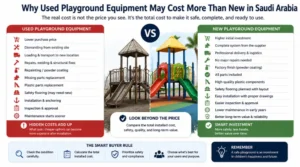
Hidden Project Costs Buyers Often Miss in Second-Hand Playground Equipment
A second-hand playground is not expensive only because of one big charge. The cost usually grows in small stages: checking the equipment, removing it from the old site, preparing it for the new location, replacing weak parts, fixing the ground area, and keeping it usable after handover.
This is where the real difference appears. A seller may quote only the playset price, but a buyer has to pay for the full ready-to-use result.
1. Compliance and Approval Requirements
Schools, nurseries, compounds, and contractor-led projects often need approval documents before installation. Older playground systems rarely come with these, so missing paperwork means extra inspections, delays, and added cost before work can even start.
2. Removal from the Existing Site
Most playground structures are securely anchored into the ground, often with concrete foundations. Removing them safely requires labor, equipment, and careful handling to avoid damaging reusable parts during dismantling and transport.
3. Renovating and Part Replacement
Once the equipment reaches the new location, every component should be checked before installation. Wear, missing hardware, damaged panels, or weakened connections may only become visible after disassembly.
Replacing these parts can add unexpected costs before the playground is ready for use.
4. Site Preparation and Installation
A playground requires more than open space. The new site may need ground preparation, proper anchoring, layout adjustments, and safe clearance zones around the equipment.
If the available area differs from the original site, the playground layout may also need modification.
5. Safety Surfacing and Finishing
The surface beneath the playground is a major cost that buyers often overlook. Existing flooring may be unsuitable, damaged, or incompatible with the new layout, requiring replacement with rubber flooring, EPDM, artificial grass with shock padding, or another child-safe surface.
Older structures may also need repainting, cleaning, or cosmetic repairs to restore a safe and presentable appearance.
6. Ongoing Maintenance
Used equipment has already consumed part of its service life. Components such as chains, bolts, joints, handles, and seats may require maintenance sooner than newer systems.
While this may be manageable for a private villa garden, maintenance costs can become more significant in schools, parks, hotels, nurseries, and residential compounds where the equipment is used daily.
Buyer Tip
Before you agree to buy a used playground, take a few minutes to check the complete project instead of looking only at the selling price.
Ask yourself:
- Is the steel frame straight, stable, and free from serious rust?
- Are all slides, panels, swings, chains, bolts, and connectors included?
- Will the equipment fit your available space without major changes?
- Does the project need new safety flooring?
- How much will transport, installation, and repairs cost?
- Can spare parts still be purchased if something breaks later?
- Is the playground safe enough for the number and age of children who will use it?
If several of these answers are uncertain, compare the total project cost with a new systems before making a final decision. A higher purchase price can sometimes save money later by reducing repairs, maintenance, and unexpected work. If the total cost of the used playground reaches around 40–50% of the cost of a new system, think carefully before buying it.
Safety Risks Buyers Often Miss When Buying Old Playground Equipment
An old playground may look clean from outside, but child safety depends on what is behind the paint, under the floor, and inside the moving parts. This is why a buyer should never judge second-hand playground equipment by photos only. A proper safety check can reveal problems that are easy to miss during a quick visit.
Compliance and Documentation Issues with Previously Installed Playgrounds
- Lack of SASO Registration – Older playground equipment may not have the documentation required for certain projects, making approval and procurement processes more difficult.
- Outdated Safety Dimensions – Some older designs may not align with current safety expectations, potentially requiring modifications before installation.
- Voided Product Warranties – Most manufacturer warranties do not transfer to second-hand buyers, leaving future repair and replacement costs fully with the owner.
- Missing Product Records and Spare Parts – Technical specifications, installation manuals, and matching replacement components can be difficult to obtain for discontinued or older playground models.
Hidden Weak Points in the Frame
Metal frames can look strong from a distance. But weak areas often appear around welded joints, base plates, swing beams, ladder sections, and places where the structure was fixed into the ground.
Paint can hide rust. A fresh coating can hide old damage. A small crack can become bigger after daily use.
This is especially important for equipment used by many children every day. Schools, nurseries, parks, and compounds need stronger inspection because the playset carries repeated climbing, jumping, swinging, and running pressure.
Before buying, check the frame closely. Look under the paint, around joints, near bolts, and at the base of each post.
Plastic Slides and Panels May Have Aged
Plastic parts do not always fail at once. They usually show small signs first: fading, rough edges, tiny cracks, loose corners, weak steps, or panels that move when touched.
A faded slide is not only a design issue. It may be a sign that the plastic has already lost some strength. Roofs, side panels, tunnel slides, stairs, and climbing panels should be checked by hand, not only by eye.
If any plastic part feels brittle, sharp, loose, or uneven, it should be replaced before children use the playground.
Used Swings Need a Separate Inspection
Swings carry constant movement, so they need extra attention. The seat may look fine, but the chain, hooks, bearings, top beam, and fixing points may already be worn.
Check these areas carefully:
- Swing chains
- Seat condition
- Hanging hooks
- Bearings or moving joints
- Top support beam
- Ground anchoring
- Load capacity
One weak hook or old chain can turn a small issue into a serious risk. If the playground is for a school or nursery, don’t skip checking the swings they take the most repeated stress of any part of the structure.
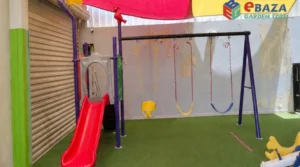
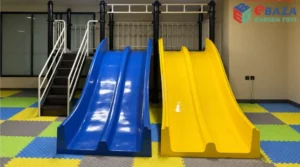
Safety Flooring Is Part of the Playground
Many buyers focus on the playset and forget the floor. But the surface under the equipment is part of child safety.
Old rubber tiles, EPDM flooring, or artificial grass underlay may not be suitable for the new site. It may be too thin, uneven, damaged during removal, or not matched with the height of the equipment.
No matter how good the equipment looks, if there’s no proper fall-safe flooring underneath it, the playground isn’t ready for kids yet.
For schools, compounds, hotels, and public spaces, fresh safety flooring may be needed even if the used equipment itself is acceptable. This can add cost, but it also protects children and reduces future problems for the site owner.
Practical Safety Advice Before Buying
Before paying for any used playground, inspect it like a project, not like a product. Check the documents, frame, plastic parts, swings, anchors, and flooring together.
A low price is only useful if the equipment can be made safe without heavy repair. If the safety work becomes too much, new systems may be the better long-term decision.
To keep the play area safe after installation, follow a proper playground maintenance guide that covers regular,weekly and monthly checks for frames, swings, flooring, anchors, and moving parts.
Saudi Climate and Material Aging: Why Outdoor Playground Quality Matters
Outdoor playground quality in Saudi Arabia should be judged by how the material performs after real outdoor use, not how bright it looks on day one. In Riyadh, summer heat can reach around 44°C, while Jeddah and Dammam add another issue: coastal humidity. These conditions test plastic, paint, steel, bolts, chains, bearings, and anchors every season.
How Saudi Arabia’s Climate Accelerates Playground Wear
In Saudi Arabia, outdoor playground equipment faces challenges that are less common in milder climates. High temperatures, intense UV exposure, dust storms, and coastal humidity can gradually affect both plastic and metal components.
During playset inspections, common issues include faded plastic panels, worn protective coatings, loose fittings, surface cracks, and early signs of corrosion around joints and anchors.
The rate of deterioration depends on material quality, manufacturing standards, installation quality, and maintenance history. This is why buyers should inspect the actual condition of a previously installed playground rather than relying on its age alone.
Riyadh, Jeddah, and Dammam Create Different Material Problems
Riyadh is hard on plastic and coating because of strong dry heat and direct sun. Slides, roofs, tunnels, steps, and side panels should be made from UV-resistant LLDPE or HDPE. Normal plastic may look fine at first, but it can become dry, faded, and brittle faster under long sun exposure.
Jeddah and Dammam are different. The issue is not only heat. It is heat mixed with humidity. Metal parts need more attention there, especially swing chains, hooks, bearings, bolts, base plates, and welded joints. If steel is not galvanized and properly powder-coated, rust can start in hidden areas before it becomes visible outside.
Material Quality Is a Cost Decision
For playground projects, material choice is not only about safety. It also affects how often the buyer will pay for repairs.
A serious outdoor playset should have:
- Galvanized steel frames
- Powder-coated finishing
- UV-resistant LLDPE or HDPE plastic
- Strong ground anchors
- Outdoor-grade bolts, hooks, chains, and bearings
- Smooth edges and replaceable fittings
Before choosing any used playground, ask one practical question: Can this material survive another two or three Saudi summers without major repair?
If the answer is not clear, the low price may not be a real saving.
For a deeper material-by-material breakdown, read our playground material comparison guide before choosing equipment for schools, compounds, villas, or public play areas in Saudi Arabia.
Is New Playground Equipment Actually Better Value?
New playground equipment can be better value when the buyer needs control, safety, warranty, and a clean installation from the start. It is not only about buying a fresh playset. It is about getting a playground that fits the site, the children’s age group, and the long-term use of the space.
New Equipment Gives Better Design Control
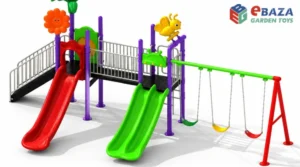
With new equipment, you can choose the size, colour, height, activities, and layout according to your space. A school may need age-based play zones. A compound may need a stronger multi-play system. A villa may need a compact swing and slide set that fits safely in the garden.
For many buyers, swings and slides are the main part of the playground. New sets are easier to check, easier to install, and easier to maintain because the frame, seats, chains, bolts, and plastic parts come ready for the selected use.
This control matters because playgrounds are not one-size-fits-all. Swings, slides, climbing frames, flooring, shade, seating, and safety zones should work together from the beginning.
Warranty and Spare Parts Make Ownership Easier
A new playground usually gives the buyer better support after installation. Spare parts are easier to arrange, warranty is clearer, and maintenance becomes more predictable.
This is important for schools, nurseries, compounds, and public-use areas where the playground cannot stay closed for long because one part is missing.
Installation Quality Matters More Than the First Price
Even a good playset can become unsafe if it is installed badly. Proper ground fixing, spacing, leveling, anchoring, and flooring all affect child safety.
That is why the final value should be judged by the complete installed playground, not only the equipment price.
This is where working with a reliable playground supplier in Saudi Arabia helps, because the buyer gets fresh equipment, clearer product details, spare parts, and better support after installation.
Planning a school, villa, nursery, or compound playground? Compare the full installed cost before making a decision. Ebaza Gardens supplies and installs indoor and outdoor playground equipment across Saudi Arabia, with an experienced team that can guide you from site review to final installation. You can request a free quote and choose a safer playground solution with more confidence.
Used vs Refurbished vs New Playground Equipment: What Is the Difference?
| Option | What It Means | Main Benefit | Main Risk | Best For |
| Used Playground Equipment | Previously installed equipment sold again | Lower first price | May need parts, repair, repainting, flooring, or inspection | Small villa gardens or light-use areas |
| Refurbished Playground Equipment | Used equipment that has been repaired or refreshed before resale | Better condition than normal used equipment | Still needs proper safety and material checking | Buyers who want a lower price but better condition |
| New Playground Equipment | Fresh equipment supplied for a selected site and age group | Better design control, warranty, parts, and installation support | Higher starting price | Schools, nurseries, compounds, parks, hotels, and commercial spaces |
In short: used saves money upfront, refurbished balances price and condition, and new gives the most control with the fewest surprises. The right pick comes down to your budget, how often the playground will be used, and how much risk you’re willing to take on.
Common Mistakes Buyers Make When Choosing Used Playground Equipment
Many used playground deals go wrong because the buyer checks the price first and the project details later. Before buying any previously installed playset, make sure these common mistakes are not hiding inside the deal.
- Buying only because the first price looks low
- Not checking rust under paint, joints, and base plates
- Ignoring transport, loading, and unloading cost
- Forgetting safety flooring under the play area
- Not measuring the site before purchase
- Buying equipment without spare parts
- Ignoring the age group the playset was made for
- Installing without professional support
- Not checking if the materials are suitable for outdoor use in Saudi Arabia
- Comparing used equipment price with the full installed price of a new playground
The real mistake is buying first and calculating the full cost later. Most of these mistakes only show up after the deal is done, when fixing them costs more than buying new would have. The fastest way to avoid all ten of these mistakes is simple: get someone to check the site and the equipment in person before any money changes hands. A five-minute phone quote can’t catch a cracked base plate or a missing bolt. Request a site visit and let someone check it in person.
The Smart Buyer’s Decision: When Used Equipment Works and When New Is Safer
A cheap deal can turn expensive fast once extra work, safety concerns, or missing support show up later. The best choice is not always “used” or “new.” It depends on the condition of the equipment, the type of site, and how much risk the buyer can accept.
Buy Used If:
- The playset is lightly used and easy to inspect
- All parts are complete and available
- It is for a small private garden or low-use area
- No major repair or repainting is needed
- The total cost stays clearly lower than a new option
Buy New If:
- The playground will be used daily by many children
- You need a proper layout, warranty, and spare parts
- The project requires clean handover and safer installation
- You want equipment selected for your site, age group, and long-term use
The simple answer is this: used equipment is only worth buying when it remains safe, complete, and cost-effective after all checks. For schools, nurseries, compounds, parks, and commercial spaces, new playground equipment often gives better peace of mind because the buyer gets clearer planning, support, and fewer surprises after installation.
FAQs
Is buying a used playground good for home gardens?
Yes, it can work for a residential backyard if the playset is small, lightly used, complete, and easy to inspect. Still, check the frame, plastic parts, swing fittings, anchors, and flooring before children use it.
How much does new playground equipment cost in KSA?
The cost of new playground equipment in KSA depends on the size, materials, age group, design, flooring, shade, delivery, and installation work. A small villa playset will cost much less than a full school, nursery, compound, or public park playground. For an accurate price, it is better to request a site-based quote so the supplier can calculate equipment, safety flooring, installation, and any extra project requirements clearly.
How does the Saudi climate affect old playground equipment?
Saudi heat, sun exposure, and coastal humidity can shorten the life of weak materials. Old plastic may fade or crack, while poor metal finishing can rust faster, especially around bolts, joints, chains, and base plates.
Do I need a SASO certificate for used playground equipment?
It depends on the project type, product source, and approval requirements. Schools, public projects, contractors, and commercial sites may ask for SASO/SABER-related documents, inspection reports, or supplier details before approval.
What materials should outdoor playground equipment be made from in Saudi Arabia?
Look for galvanized steel frames, powder-coated finishing, and UV-resistant plastic such as LLDPE or HDPE. These hold up better against heat, sun, and coastal humidity than standard outdoor-grade materials. If a seller can’t tell you the exact plastic or steel grade used, ask again before you buy.
What should I check before choosing a playground supplier in Saudi Arabia?
Ask three things: Do they install locally, or just sell equipment? Can they provide SASO or SABER-related documents if your project needs them? Do they offer a warranty or spare parts after installation? A supplier who can answer all three clearly is a safer choice than one offering only a low price.
What if a part breaks or we need an urgent safety inspection?
A local supplier can usually get spare parts and repair support to you faster than a used or discontinued model that needs imported parts. Before you buy anything, ask directly: “If this breaks in six months, where do the replacement parts come from, and how long will it take?” If the answer is vague, that’s a real risk, not a small detail.
How often should outdoor playground equipment be inspected in Saudi Arabia?
Because of the heat and humidity, a proper check every three to six months is a reasonable standard more often for equipment used daily by many children, like in schools or compounds. Focus each check on rust under paint, swing chains, bolts, and the condition of safety flooring underneath.