.png)

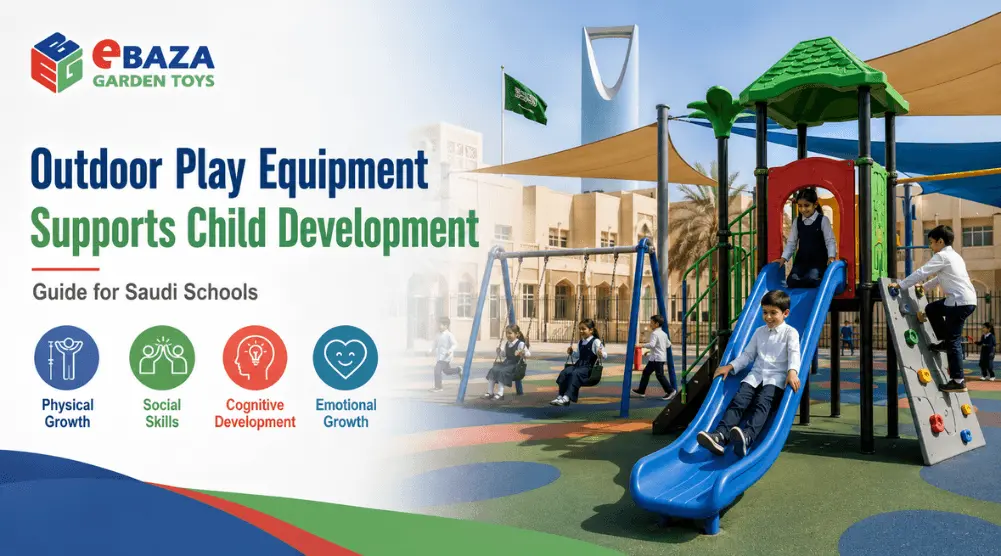
How Outdoor Play Equipment Supports Child Development — A Guide for Saudi Schools
Outdoor play equipment supports child development when it gives children more than a place to spend break time. In a school or nursery, the right playground helps children move better, build confidence, learn patience, make friends, and return to class with a calmer mind.
For Saudi schools, this matters even more. Children spend long hours sitting, following routines, and using screens. A well-planned outdoor play area gives them space to climb, swing, balance, run, imagine, and learn through real movement. But equipment alone is not enough.
The playground has to match the children’s age, daily use, safety needs, flooring, shade, and Saudi weather. When these details are planned properly, the outdoor area becomes a useful part of the school environment, not just an empty space with play items.
This guide explains how outdoor play equipment supports child development and how Saudi schools can create safer, stronger, and more useful playground spaces for children of different age groups.
The Five Areas a School Playground Works On
A school playground works on five things at once: strength, social skills, emotions, thinking, and the senses. Here is how each one shows up during normal play:
| Development Area | Playground Activity | How It Helps Children |
| Physical growth | Climbing, swinging, running, balancing | Builds strength, coordination, balance, and body control |
| Social skills | Group play, waiting turns, shared equipment | Teaches patience, sharing, communication, and teamwork |
| Emotional growth | Safe climbing, small challenges, independent play | Builds confidence, courage, and self-control |
| Cognitive skills | Multi-activity playsets, movement choices, pretend play | Supports planning, problem-solving, focus, and imagination |
| Sensory development | Swings, slides, textured flooring, outdoor movement | Helps children understand speed, touch, height, space, and rhythm |
This is why a school playground should be planned as part of the learning environment, not treated as a decoration.
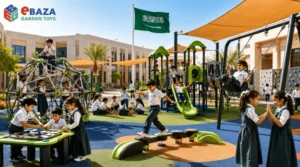
How Playground Activities Support Healthy Childhood Growth Physically
Children don’t build strong bodies by sitting all day. They need to move. Climb. Push. Pull. Balance. Fall a little, get up, and try again.
That is where school playground equipment does real work. Climbing improves arm, leg, and core strength. Slides help children control their body as they sit, move, and land. Swings support balance and coordination because the child has to hold, lean, and adjust with the motion.
Monkey bars are tough, but useful. They build grip strength, shoulder control, and confidence. See-saws teach rhythm, timing, and leg control because children have to work with another child, not alone.
For older children, outdoor gym-style movement stations can also help. Air walkers, stepping machines, and simple fitness stations give them a way to stay active without turning every break into a formal sports class.
Physical development starts with these small daily movements. Not one big activity. Daily use.
Swings, Slides, and Climbing Frames Help Build Gross Motor Skills
Gross motor skills simply mean how children use the big muscles in their body. Running to the slide. Climbing the stairs. Holding the rails. Sitting down properly. Pushing on a swing. Balancing before moving to the next part of the playset. These actions look normal, but they train the body.
A child using a climbing frame has to think where to put the next hand and foot. A child going down a slide learns posture, speed, and landing. A child on a swing learns how to hold tight, move with rhythm, and control their body.
This is how playground activities support healthy childhood growth by turning normal movement into daily physical practice. And children enjoy it. That matters.
Playground Equipment Improves Balance, Coordination, and Body Control
Younger children are still learning how their body moves. They don’t always judge distance well. They may run too fast, step too wide, jump too early, or land awkwardly. Playground equipment helps them learn these things in a natural way.
Balance beams teach careful steps. Climbing nets train hands and feet to work together. Low platforms help children understand height. Stepping pods teach timing, space, and control.
Nursery children and younger school children need this type of movement often. It helps them feel more steady, more aware, and less afraid to try new physical tasks.
For nursery and early years children, low platforms, stepping pods, balance paths, and small climbing units can support this learning without making the play area too risky.
Active Play Helps Reduce Sitting Time During the School Day
Children sit more than people think. They sit in class. They sit in cars. They sit at home with screens. After a while, the body needs a proper reset. Outdoor play gives them that. A short playground break can help children release extra energy, stretch their muscles, and come back to class calmer. Not perfect. They are still children. But usually better than before.
Schools don’t always need a full sports period to support daily movement. A safe playground can give children regular physical activity between lessons, during breaks, or as part of a planned outdoor routine. That’s the point. More movement, every day.
How Outdoor Play Equipment Supports Child Development Socially
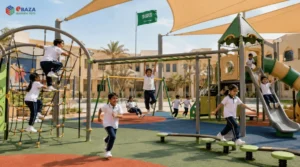
Children rarely use a slide or swing on their own. They share it, wait their turn, or argue over it. This is where real social learning happens. That changes everything. One child wants the swing. Another is already sitting on it. Someone runs to the slide before their turn. A younger child gets stuck on the climbing step and needs help. These small moments happen every day in a school playground, and this is where children slowly learn how to wait, speak, share, adjust, and behave around others.
Children Learn Turn-Taking, Sharing, and Patience
A slide queue is a simple thing, but it teaches a lot. Children learn that they can’t always go first. Swings with limited seats teach the same lesson. They wait, ask, complain sometimes, then try again. That’s normal.
Around play towers, children also learn to give space. One child climbs up, another moves down, someone stops in the middle, and the rest have to manage. These moments build patience better than a lecture ever could.
Group Play Builds Communication and Teamwork
Playgrounds make children talk. They make plans, change rules, choose who leads, and decide what the game becomes. A climbing frame becomes a house. A slide becomes a race. A play tower becomes anything they imagine that day.
Teachers can also notice things outside that don’t always show inside the classroom. Who helps others? Who takes over too much? Who gets left out? Who needs a little support?
For schools and nurseries, this is valuable because teamwork in children grows through real play, not forced activities.
Outdoor Play Helps Children Make Friends More Naturally
Some children don’t know how to start a conversation in class. Outside, it’s easier. They can run beside another child. Wait near them. Push a swing. Join a game without saying much at first. The pressure is lower because the play is already happening. That’s why playgrounds help shy children too. They give them a simple way in. Not perfect. Not instant. But real.
Emotional Benefits of Outdoor Play Equipment for School Children
A playground also works on the child’s emotions. Not in a loud way. Quietly. A child climbs a small platform for the first time. They stop halfway. Look down. Maybe they feel scared. Then they try again, hold the rail tighter, take one more step, and finally reach the top. That moment matters.
It builds child confidence because the child feels, “I did it.” No one can give that feeling through a worksheet. They have to experience it.
Outdoor play also teaches independence. Children choose what to try, how far to go, when to stop, and when to try again. Sometimes they fail. Sometimes they get frustrated. But with safe playground equipment for schools, proper flooring, and teacher supervision, these small failures become healthy learning moments.
They learn to manage fear. They learn patience. They learn not to quit too quickly.
Safe Challenges Help Children Build Confidence
Children need small challenges, but not dangerous ones. A low climbing frame, a balance path, a small slide, or a platform with proper handrails can give children the right level of difficulty.
Nursery children need lower equipment and softer movement. Older children can handle more climbing, height, and active play. When the equipment matches the age group, children can repeat the same task until they feel stronger and more confident. This also helps children understand small risks. They learn how high something feels, how fast they are moving, when to slow down, and when to ask for help.
Cognitive Development: How Outdoor Play Helps Children Think Better
Outdoor play is not separate from learning. Children think while they move. They decide where to climb first, which slide to use, how fast to run, when to stop, and how to move around other children without bumping into them. That is real decision-making.
A playground also helps children build spatial awareness. They start to understand height, distance, speed, and direction through daily play. Over time, these small choices support problem-solving, focus, memory, and better attention back in class.
Climbing and Multi-Activity Playsets Encourage Problem Solving
Multi-activity playsets make children plan.
They ask themselves simple questions without even noticing:
- How do I get from this platform to the slide?
- Can I climb from this side?
- Where should I hold it?
- Should I wait or move now?
This is why multi-activity equipment is useful for schools. One playset can give children many choices, not just one fixed movement. They climb, cross, slide, wait, and try again. That keeps the brain active.
Outdoor Movement Can Improve Focus Back in the Classroom
Children can’t sit for long hours and stay fresh all the time. Active play helps them release extra energy in a better way. After running, climbing, or swinging, many children return to class calmer and more ready to listen. It doesn’t need to be complicated.
Schools can schedule short outdoor sessions during the day, especially for younger children. A few minutes of proper movement can make the next lesson easier to manage.
Sensory Development Through Outdoor Playground Equipment
Children learn through their senses. They touch different surfaces, hold rails, grip handles, feel rubber flooring under their feet, and notice how their body moves on swings, slides, and climbing steps.
This kind of play supports sensory development in a natural way. They feel movement when they swing. They understand balance when they climb. They notice sound during group play. They see colors, shapes, height, and distance around the playground.
For nurseries and early years areas, this matters a lot because young children learn best when their body is involved.
Swings, Slides, and Spinners Support Movement Senses
Swings help children feel rhythm and balance. Slides teach speed, body position, and landing control. Spinners and rounders can also support movement senses, but schools should choose them carefully. Age matters.
Younger children need slower, safer, and easier equipment. Older children can handle more movement, but the design still has to be safe and supervised.
Rubber Flooring and Safe Surfaces Add Comfort and Protection
Rubber flooring for school playgrounds gives children a safer surface under slides, swings, and climbing areas.
It helps reduce injury risk from falls and makes the play area more comfortable for daily use. It also helps schools divide the playground into clear zones, such as climbing areas, swing areas, and early years play areas.
For schools, nurseries, and early years spaces, safety surfacing is not a small detail.
It is part of the playground plan. Good playground flooring in Saudi Arabia should handle daily use, heat, dust, and regular cleaning without becoming a problem for the school.
What Types of Outdoor Play Equipment Are Best for Saudi Schools?
Not every outdoor playground set fits every school. A nursery doesn’t need the same setup as a primary school. A small private school won’t use the same layout as a large campus with hundreds of children. The right choice depends on age group, available space, number of students, supervision, safety flooring, shade, and how often the area will be used.
For Saudi schools, the best outdoor play equipment usually includes a mix of:
- Swing and slide playsets for daily active play
- Multi-activity playground sets for climbing, sliding, and group movement
- Climbing frames to build strength and body control
- Tube slides and spiral slides for more exciting play zones
- Spring riders for younger children
- See-saws for balance, timing, and shared play
- Monkey bars for grip strength and confidence
- Rubber flooring for safer landings
- Shade structures to make the area more usable
- Outdoor fitness equipment for older students
- Benches and dustbins to keep the space organized and easier to manage
Best Playground Equipment for Nurseries and Early Years
Nursery playgrounds should stay simple.
Lower platforms, smaller slides, spring riders, soft rubber flooring, and easy-to-watch layouts work best. Bright colors help, but the design shouldn’t feel crowded. Teachers need clear sightlines, and children need equipment they can use without too much risk.
For this age, fewer high climbing points are better. Safe movement first.
Best Playground Equipment for Primary Schools
Primary school children need more challenges. Multi-activity playsets, climbing frames, slides, swings, monkey bars, and group play areas work well because children at this age want variety. They don’t stay on one item for long. They climb, run, switch, compete a little, and make their own games. Daily use also matters here. Frames should be strong, flooring should handle heavy foot traffic, and the layout should allow children to move without crowding one tight corner.
Best Outdoor Equipment for Older Students
Older students usually need equipment that feels less like a children’s playground. Outdoor fitness stations, balance equipment, climbing units, open activity zones, and sports-style movement equipment can work better for them. These areas help students stay active during breaks without needing a full sports class every time.
A good setup gives them space to move. Not just sit. You can also read our detailed guide on how to set up an outdoor playground area for schools and nurseries if you want a clearer plan for layout, flooring, shade, and equipment selection.
For schools starting from zero, this guide on outdoor playground setup for schools and nurseries explains the basic steps before buying any play equipment. For a clearer age-based breakdown, you can read our guide on best outdoor playground equipment by age group in Saudi Arabia. It explains which play equipment works better for toddlers, nursery children, primary school students, and older children before choosing a final playground setup.
How to Choose Safe Outdoor Playground Equipment for Schools in Saudi Arabia
A school playground should look good, yes. But first, it has to work safely every day. Start with the basics: the children’s age, the space size, the ground surface, shade, equipment spacing, and how many students will use the area at one time. These details decide what type of playground equipment makes sense.
Choose Materials That Can Handle Saudi Weather
For school playground equipment in Saudi Arabia, weak materials don’t last long. Choose heavy-duty iron or steel frames, galvanized structure, powder coating, and UV-resistant plastic like LLDPE. The equipment should handle sun, dust, humidity, and daily school use without fading, rusting, or getting loose too quickly. If the school is near coastal areas, anti-rust finishing matters even more.
Check Age Group, Height, and Fall Protection
Nursery children need low platforms, small slides, and simple movement. Primary school children can use bigger playsets, climbing frames, swings, and monkey bars, but the height and spacing must still be planned properly. Crowded layouts create problems. Children need space to move.
Professional Installation Matters as Much as the Equipment
Good equipment can still become unsafe if someone installs it badly. Anchoring, leveling, spacing, flooring edges, and bolt fixing all matter. Schools should work with a team that understands playground installation, not just general labor.
Common Mistakes Schools Make When Buying Outdoor Play Equipment
Many school playground problems start before installation. Usually, the mistake is simple: the school buys equipment first and plans the space later. That creates safety issues, crowding, and extra repair costs.
Common mistakes include:
- Buying only because the price is low
- Choosing equipment too big or too small for the children’s age
- Ignoring rubber flooring under slides, swings, and climbing areas
- Forgetting shade and sun exposure
- Not checking frame strength, coating, and plastic quality
- Using indoor-style plastic in outdoor heat
- Poor anchoring and weak installation
- Leaving no maintenance plan
- Not planning how children will enter, exit, and move around the area
Cheap Equipment Can Become Expensive Later
Cheap playground equipment may look fine on day one. After a few months, the problems show up. Rust on the frame. Faded plastic. Broken swing seats. Loose bolts. Weak chains. Unsafe flooring edges. Then the school has to pay again for repairs, replacements, or full removal. Worse than the cost, it can affect student safety and the school’s reputation.
A Playground Should Be Planned Like a School Facility, Not a Decoration
A school playground is not just something to fill an empty corner. It needs planning.
Think about student numbers, daily use, teacher supervision points, entry and exit flow, shade, drainage, and maintenance access. Children should move easily from one activity to another without crowding or cutting across unsafe areas. Good planning makes the playground safer, cleaner, and easier to manage every day.
Before choosing the final equipment, it helps to look at the playground as one complete space, not separate items. Ebaza Gardens can support schools with site review, 2D and 3D layout views, and practical equipment suggestions based on the children’s age, space, flooring, shade, and daily use.
You can also check our completed projects to see real playground installations done in different Saudi cities, not just catalog images. That gives schools a clearer idea of what works on actual sites before starting their own project.
Sample Outdoor Play Area Plan for a Saudi School
A good school playground plan should match the children’s age, daily use, space size, and supervision needs. It doesn’t have to be crowded. It has to work.
For a nursery, the setup can include:
- Small slide unit
- Low climbing structure
- Spring riders
- Rubber flooring
- Shade
- Benches for teachers or supervisors
For a primary school, the play area can include:
- Multi-activity playset
- Swings
- Monkey bars
- Climbing frame
- Rubber flooring
- Shaded seating
- Dustbins near the sitting area
For a larger school, it is better to divide the space into zones:
- Early years play area
- Main playground for primary children
- Outdoor fitness area for older students
- Separate safety flooring and shade in each zone
Small School Playground Setup
A small school should keep the layout simple. Compact equipment, a clear walking path, soft flooring, and easy supervision matter more than adding too many items. This also helps control the budget without making the playground feel empty.
Medium to Large School Playground Setup
Bigger schools need better flow. Use separate zones for different age groups, higher-capacity playsets, stronger frames, and wider movement areas. Children should be able to enter, play, and move out without crowding around one slide or swing area.
Why Saudi Schools Should Work With a Playground Supplier Who Understands Local Projects
Saudi schools should work with a playground supplier who understands local site conditions, not only product catalogs. The supplier should know how heat, dust, humidity, student capacity, flooring, shade, and installation quality affect the final playground.
For schools and nurseries, this reduces mistakes before installation starts. A local project-focused supplier can help with layout planning, age-appropriate equipment, material selection, rubber flooring, delivery, installation, spare parts, and after-sales support.
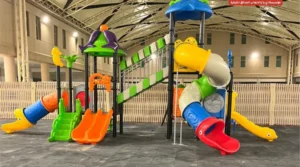
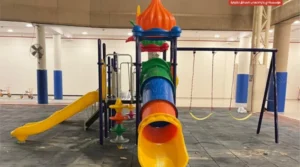
Ebaza Gardens recently completed an outdoor playground installation for a school in Riyadh, supplying multi-activity play towers, tube slides, a separate swing set, spring riders, and rubber tile flooring across the play area, with part of the setup placed under a covered shade structure to keep it usable throughout the day.
If your school or nursery is planning an outdoor playground in Saudi Arabia, Ebaza Gardens can help with equipment selection, 2D/3D layout planning, rubber flooring, installation, and after-sales support. Share your space size and age group with our team, and we’ll help you plan a playground that works on-site, not just on paper.
Contact Ebaza Gardens expert team to plan your outdoor school playground area.
A Better Playground Builds Better School Days
Outdoor play equipment supports child development when it gives children space to move, think, share, and grow with confidence. For Saudi schools, a playground is not just a break area. It helps children build motor skills, balance, coordination, social habits, emotional control, and problem-solving skills through daily play.
But the setup matters. The right playground should match the children’s age, school space, safety flooring, shade needs, and daily use. Strong materials, proper installation, clear layout, and after-sales support all make the difference between a play area that looks good for a few months and one that works for years.
For schools and nurseries planning a new outdoor play area, start with the site, the age group, and the purpose of the space. Once these are clear, choosing the right equipment becomes much easier — and much safer.
FAQs
Why should schools install outdoor playground equipment in KSA?
Schools in KSA should install outdoor playground equipment to give children daily physical activity after long hours of sitting in class. It also builds strength, social skills, and confidence in children while giving teachers a natural way to supervise group behavior outside the classroom.
How does playground equipment help child development?
Playground equipment builds physical strength, balance, and coordination through climbing, swinging, and sliding. It also builds social skills through shared play, confidence through small challenges, and focus through decision-making during movement.
Why is play important for child development?
Play builds a child’s body, social skills, emotions, and thinking ability at the same time. Movement builds strength, group play builds patience and communication, and small challenges build confidence.
What skills does outdoor play develop in children?
Outdoor play develops gross motor skills, balance, and coordination through physical movement. It also develops sharing, patience, and teamwork through group play, and focus and problem-solving through decision-making.
How does outdoor play support social development?
By placing children in shared spaces where they take turns and communicate. Sharing equipment with other children builds patience and teamwork naturally.
How does outdoor play develop cognitive and physical skills?
Outdoor play develops physical skills through running, climbing, jumping, and balancing, while building cognitive skills through problem-solving, decision-making, spatial awareness, and judging distance and movement.
What can children gain from outdoor activities?
Children gain stronger muscles, better balance, and improved coordination from outdoor activities. They also gain confidence from physical challenges and better focus in class from releasing energy.
What should schools consider before installing outdoor playground equipment?
Schools should consider the children’s age group, available space, and ground surface before choosing equipment. They should also plan for shade, safety flooring, and how many students will use the area at one time.
Which are the best equipment for schools to install in KSA?
Schools in KSA must install swings, slides, climbing frames, and multi-activity playsets as core equipment for daily active play. Monkey bars build grip strength, see-saws build balance, and rubber flooring under all equipment is required for safety and injury prevention.